
On November 18, Voyager I passed a milestone. At about 5 AM that morning (EST), it surpassed a distance of 1 light-day from Earth. It took more than 49 years for it to travel this distance.
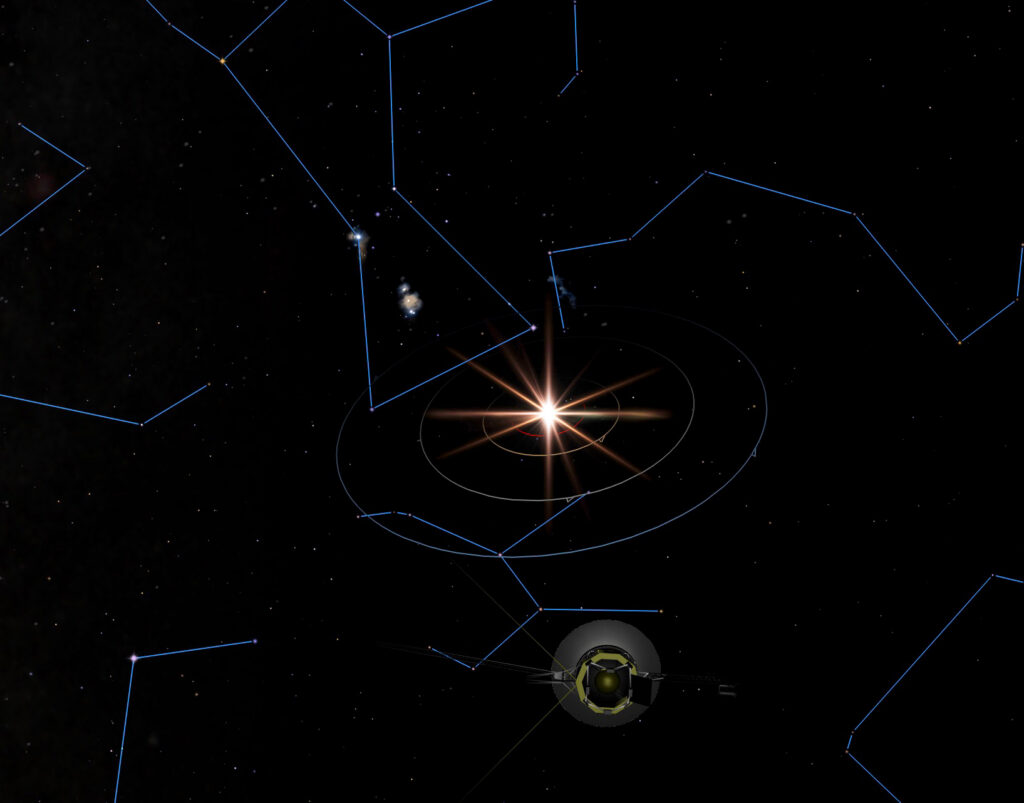
Voyager’s cameras have long since been turned off to conserve spacecraft power, but it sparked my imagination—what would Voyager see if it could take a picture from its perch? So I fired up my favorite planetarium software (Starry Night Pro version 8) and tried to simulate the view.
Voyager I is about 35 degrees north of the ecliptic plane, in the direction of the constellation Ophiuchus, and about 16 billion miles from the Earth. If it looked back our way and snapped a picture, this would be the view.
First, even at that distance, the Sun would be overwhelmingly bright (about magnitude -15.7). Imagine for a moment Venus at its twilight brightest (mag -4.9). At this distance, the Sun would be about 17,000 times brighter. It wouldn’t be dangerous to look at, or harm your optics. But it would be like the difference between a candle and a powerful spotlight. The Sun would overwhelm the background stars and render them invisible. But if you could somehow compensate for that, consider the picture again.
The Sun would be about 4 degrees south of Rigel in the constellation Orion, near the border of Orion and Lepus. I have drawn the orbits of Jupiter, Saturn, Uranus, and Neptune. At this scale, the orbital paths of Earth and Mars are hidden behind the glare of the Sun (Earth is only 12 arcminutes from the Sun).
Voyager’s cameras will never take a photo like this, but it’s a fun way to commemorate the occasion and consider how far we’ve come in 50 years.
Note 1: I added a rendition of the spacecraft itself to my picture, so technically, this is what we would see if we were floating along with Voyager I as it continues its voyage to the stars. I have its dish pointed back at Earth so it can continue to transmit data.
Note 2: Incidentally, the Voyager spacecraft did not have a camera capable of taking a photo like the above. It had a wide-angle camera (actually a slow-scan Vidicon tube sensor), but it was only capable of capturing context around its main targets (planets and moons from relatively close range). In 1990, when it was still MUCH closer to our solar system, it did take a “family portrait” shot of the Sun and the visible planets, but it had to pan-and-scan the whole platform to capture a 60-frame mosaic, which was then painstakingly reassembled by JPL imaging specialists. Read about that project here.
Note 3: From this distance, the Sun would actually not be a point source. It would subtend an angle of 11 arcseconds. That’s pretty small, but not a point. It’s about the size of a modest 20 km crater on the Moon through a small telescope. Earth would be about 12 arcminutes away from the Sun, and would shine at a magnitude 7.4 (about the brightness of Neptune, as seen from Earth). Jupiter would be about 1.5 degrees from the Sun and shine at magnitude 5.5. If Voyager’s narrow-angle camera attempted to capture these views, it would almost certainly fail due to the overwhelming glare of the Sun.
(Posted by John Rummel, November, 2026)