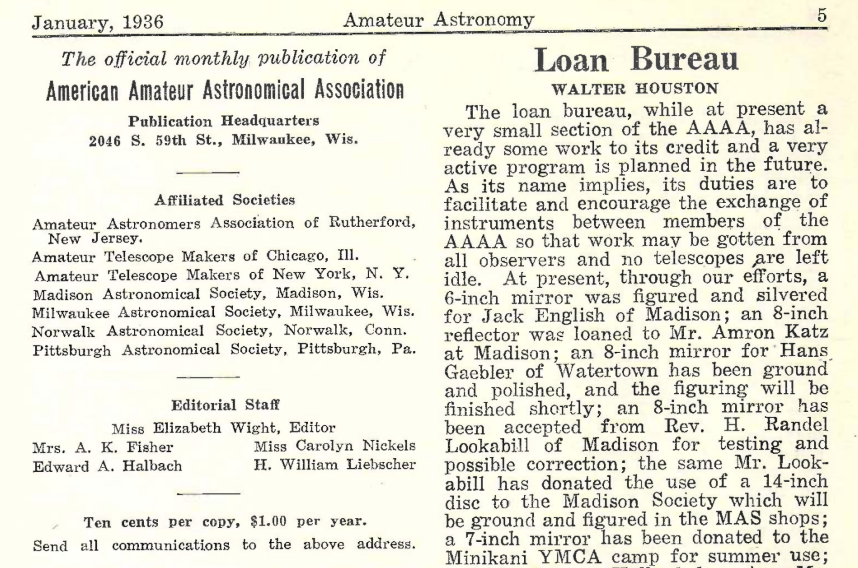
It was January of 1936 and the Madison Astronomical Society—not yet a year old—joined a brand new affiliation of astronomy clubs called the American Amateur Astronomical Association. The AAAA was founded in 1935 and was the brainchild of Edward Halbach of Milwaukee. Halbach is a legend in the world of amateur astronomy and had been instrumental in the founding of the Milwaukee Astronomical Society in 1932. Though it had the support of more than a dozen astronomy clubs at its peak in 1938, the AAAA proved to be untenable, or perhaps just ahead of its time. After 1938, it ceased activities.
The loose affiliation of astronomy clubs would continue to meet and organize for most of the next decade and at a Detroit meeting in 1946, the final plans for what would become the Astronomical League were in put in place. At a meeting in Philadelphia in July of 1947, the Astronomical League was officially launched.
The Madison society was involved from the very start. MAS members Harold Porterfield and Charles Huffer were instrumental in the formation of the North Central Region (NCRAL) and hosted the first NCRAL conference in 1949. It would host another in 1960, and Madison would go on to host no fewer than three national conventions (1954, 1978 and 1993). Many other MAS members served as delegates to the League over the years including the influential Paula Birner Carey, who helped found the MAS and would do the same for the Racine Astronomical Society in 1956. For nearly fifty years, MAS and the AL enjoyed a mutually beneficial relationship.
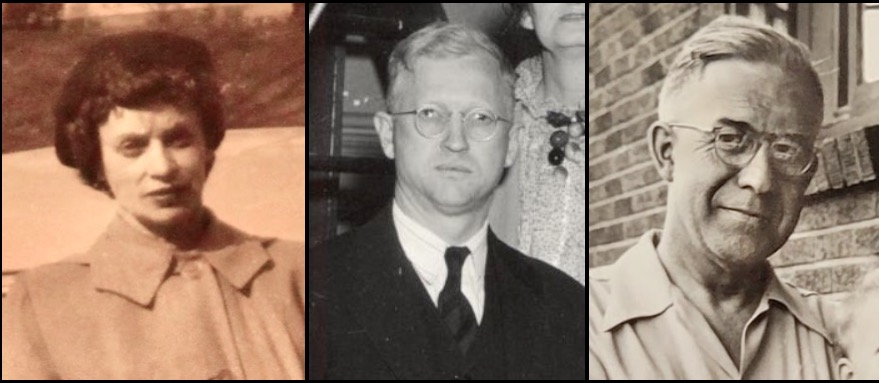
During these decades, MAS itself thrived. The club enjoyed an unusually close relationship with the Astronomy department at the University of Wisconsin-Madison. The previously mentioned Charles Huffer was a professor there and served as the MAS board secretary for over 20 years, until his retirement in 1961. This relationship provided our club with a steady flow of first-rate speakers for MAS meetings—a tradition that continues to this day. In the early years, MAS meetings took place on the UW campus proper, and today we continue to meet at an off-campus facility, UW’s Space Place, located on Park Street in Madison.
The University of Wisconsin-Madison, through a donation, also provided MAS with its first observatory in 1960. UW-Madison’s on-campus observatory—The Washburn Observatory—had a second domed building known as the “Student Observatory.” Originally built in 1880, it was intended as a place for graduate students to sharpen their skills without infringing upon their mentors’ use of the larger scope in the main observatory. By the 1950s, research in both observatories was on the wane because of increasing light pollution and industrial haze in rapidly growing Madison. The UW-Madison, like most research universities, was moving its astronomical observing to mountain tops in the American southwest and elsewhere. The university needed to get rid of the smaller building, and Dr. Huffer recommended that it be donated to the MAS, provided that the club make arrangements to move it off campus.
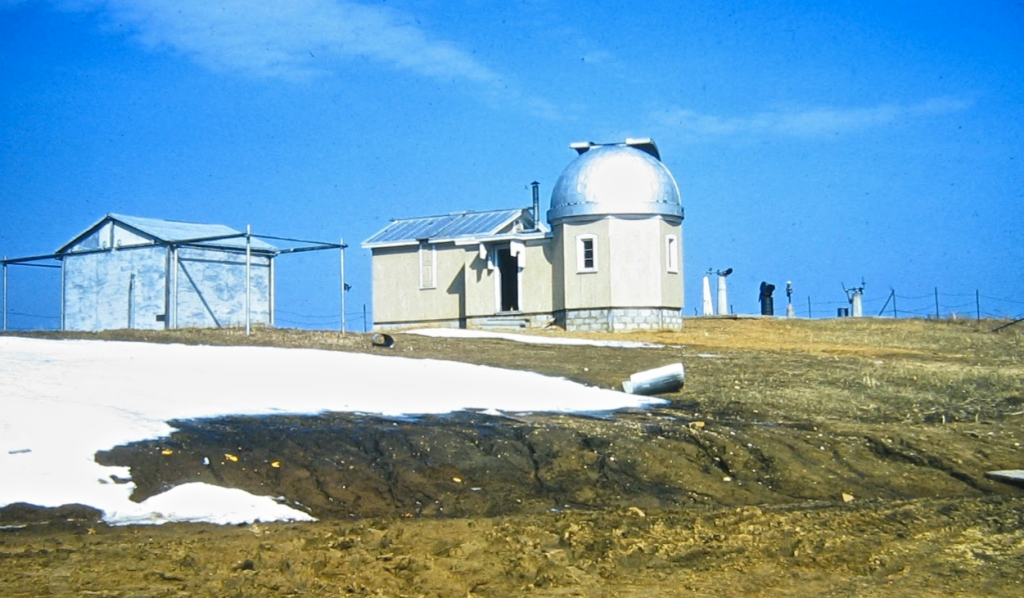
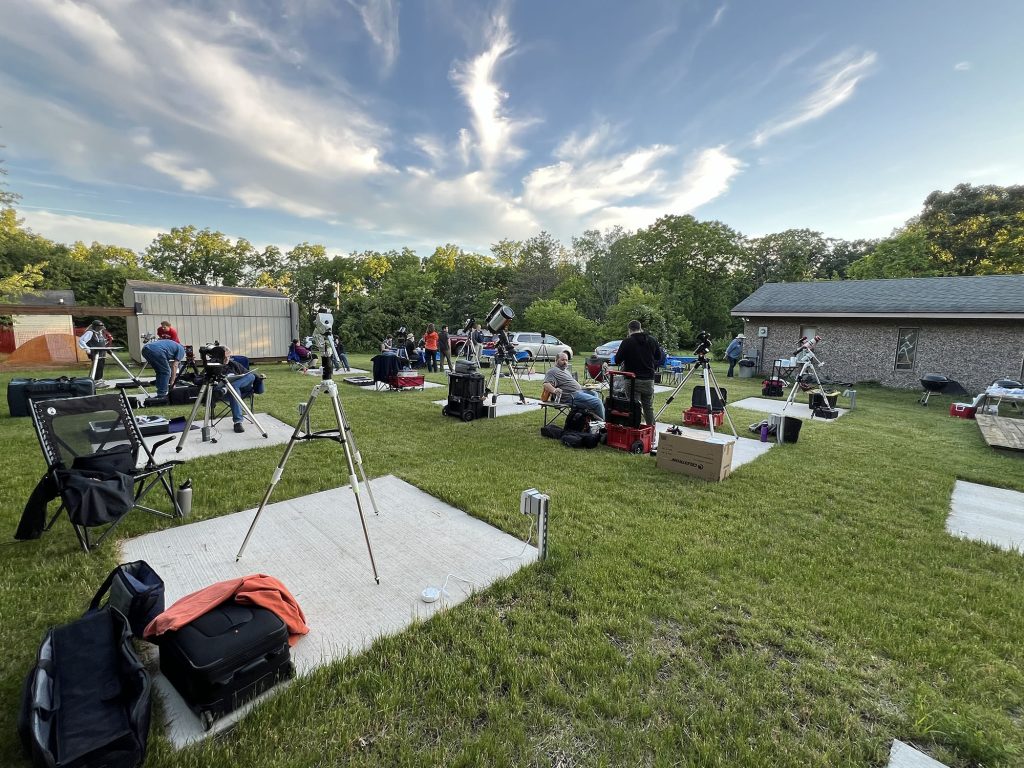
Funds were raised, volunteer labor recruited, and in July 1960, the building was hauled about 5 miles south of Madison to land the club leased from a local chemical corporation, and the building was rechristened the “Oscar Mayer Observatory” for the meat-magnate Oscar Mayer, himself an astronomy enthusiast who donated money to help with the move. The OMO was MAS’s observing home until the mid-1980s, when development and light pollution extended well beyond the 5-mile buffer the club had acquired when the observatory was moved in 1960. In the mid-1980s the club acquired land in Green County, an additional 15 miles to the south. Named for the land donor, the Yanna Research Station became the club’s dark sky home. It has been developed and expanded over the years and hopefully will continue to serve the club’s needs for many years to come.
Unfortunately, by the 1990s, the relationship between MAS and the AL fell on hard times. In 1993, the club hosted the AL’s national convention. Though by all accounts the event was a huge success, feelings were strained and words were exchanged between the two organizations. It’s not completely clear exactly what transpired but there were evidently disagreements about the format of that convention, where MAS, as the host society, wanted to break with tradition and use a workshop format instead of the traditional reading of papers. That and apparent disagreements over the disbursements of profits led the board of MAS to vote the following fall to withdraw from the AL after nearly a half-century of association. The vote to leave was not without controversy. The decision required concurrence by the general membership, and the board brought it up at 3 or 4 consecutive meetings before they achieved a majority decision to sever the ties.
From the mid-1990’s on, the topic of rejoining the League would surface every few years and members who recalled the 1993 convention would reiterate their reasons for leaving (or their regrets) but after a few years, NOT being an AL affiliate became the norm. By the second decade of the 21st century, few members remained who knew anything about the debate. Today, many MAS members are simply unfamiliar with the AL’s mission and programs and know nothing of the deep ties and traditions the two organizations share.
As is often the case, however, a seemingly small event can lead to much bigger change. That is just what happened this spring. MAS hosts an email list that we use to alert our members to upcoming opportunities. One of our members noted that the NCRAL was hosting its annual meeting in Wisconsin (De Pere) in May of 2024. The email chatter went something like this:
“Is anyone planning to attend?”
“No, MAS is not a member of the Astronomical League.” (It had long since been forgotten the NCRAL conventions were open to the public!).
“Well why don’t we belong? It looks like something our members would enjoy.”
Another member rehearses the hazy history of MAS’s decision to leave the AL.
“Well, that’s ancient history. MAS should offer these sorts of things as member benefits!”
Though the same discussion had taken place many times over the years, something was different this time. A threshold had been reached. In the previous several years, MAS had gained a handful of new members (recent retirees who had moved to the area) who had been happily involved AL-affiliated clubs far from Madison. These folks joined the conversation and spoke convincingly about the benefits of AL membership. Our Board tasked one of the authors to research the AL and report what the advantages of rejoining might look like. Happily, in early August, the MAS Board voted unanimously to rejoin the AL on the “partial club” plan. Beginning with our next membership renewal notice, and after nearly thirty years, MAS members will once again have to opportunity to participate in the AL and NCRAL. It’s good to be home!
(posted by John Rummel and Jack Fitzmier, September 2026)
Back to More MAS History.