
Lights Out Wisconsin is a coalition of Wisconsin conservation groups and dark sky organizations working together to reduce the impacts of light pollution.
Nearly 80% of Americans can no longer see the Milky Way from where they live because of light pollution. Whole generations are growing up without ever seeing our own galaxy, and without dark skies, meteor showers become invisible as well.
By taking simple steps at home, you can help restore night skies across Wisconsin so everyone can enjoy the wonders above.
💡 Useful – Light only when and where it’s needed.
⬇️ Targeted – Aim fully shielded lights downward.
✨ Low Level – Use the lowest brightness needed.
⏱️ Controlled – Use timers or motion sensors.
🟠 Warm-Colored – Choose warm lights (2200K or lower).
📲 Share this post to help more people experience Wisconsin’s night skies.
Learn more and sign up for Lights Out alerts at lightsoutwi.org.
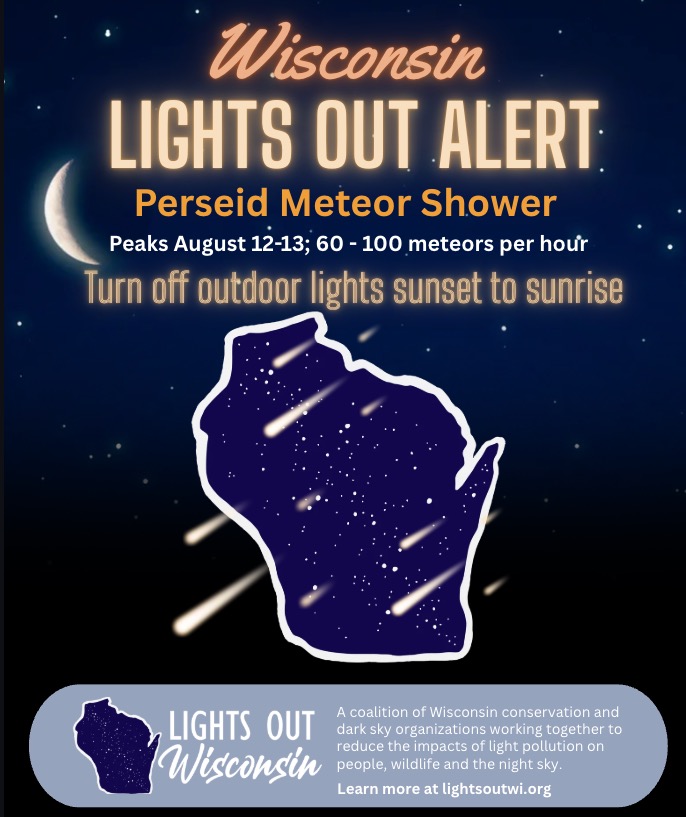
What to watch for this month:
The Perseid Meteor Shower is one of the year’s most spectacular night sky events, and this year, viewing conditions should be especially good thanks to dark, moonless skies. The shower peaks the nights of August 12 and 13. You may see up to 60-100 meteors per hour.
While you’re watching…
Keep an eye out for more than just meteors! Depending on viewing conditions, you’ll also have the chance to spot these planets all month long:
Easy – naked eye observations
- 🪐 Venus — the brightest planet and the brightest object in the sky after the sun and moon. Venus shines brilliantly in the western sky just after sunset. It’s visible all month but will slowly get lower in the WSW as the month progresses. Venus will be joined by the crescent moon on August 15 and 16.
- 🪐 Saturn — rising in the east after midnight. Will be very close to the last quarter moon in the early morning of August 3 and 4.
- 🪐 Mars — rising in the east before sunrise. Very close to the waning crescent moon on August 9
More challenging observations – binoculars may help
- 🪐 Jupiter/Mercury — the largest and smallest planets in the solar system will appear VERY close in the sky just before dawn on the morning of August 15. Look very low in the east about 30-45 minutes before sunrise. Jupiter will be very bright but very low on the horizon. Mercury will be dimmer, just to the left and slightly above Jupiter. The two planets will be separated by only ½ degree, about the width of the full moon. Jupiter will be easy to spot. Binoculars may help you to catch Mercury, which will be a little harder to see depending on how much the impending dawn is brightening your sky.
Plus, don’t miss the total lunar eclipse just after sunset on August 27. This infrequent and dramatic event is great for family viewing, not too late at night and no special equipment required! By about 9 PM, you’ll notice a darkening along the lower left edge of the full moon. This is the encroaching shadow of the Earth, cast by the sun, now below the horizon behind you. Watch over the next few hours as the moon’s disk will be nearly completely covered by the shadow, creating a nearly total lunar eclipse. The moon’s disk will turn a deep orange color.