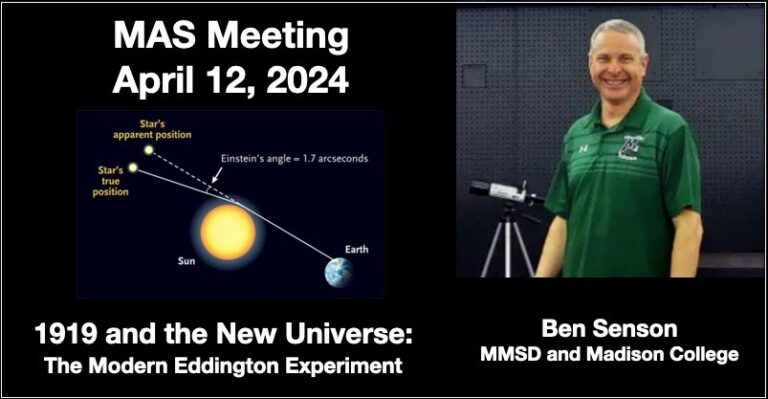
• 1919 and the new Universe… Echos and Beyond, the Modern Eddington Experiment

    Friday April 12, 2024, 7:00pm – UW Space Place

    When Einstein published his general theory of relativity it reinvented one of the most fundamental characteristics of the Universe, and as such it came with predicted phenomena that would settle the issue of whether or not the “King” of Newtonian gravitation was really dead. One of the predictions concerns the existence of a value for the curvature of spacetime based on the presence of mass. Given sufficient mass, like that of a typical yellow G2 star, it was predicted that the “straight line” motion of a beam of light through space-time would have to have this curvature of spacetime itself encoded on its path through a deflection of the observed location of the source of the light compared to an observation made when the massive object was not along the line of sight. In his 1911 paper, “On the Influence of Gravitation on the Propagation of Light” Einstein draws the conclusion that… “A light ray going past the Sun would accordingly undergo deflection by the amount of 0.83 seconds of arc. The angular distance of the star from the center of the Sun appears to be increased by this amount. As the fixed stars in the parts of the sky near the Sun are visible during total eclipses of the Sun, this consequence of the theory may be compared with experimental evidence. … It would be urgently wished that astronomers take up the question here raised, even though the considerations presented above may seem insufficiently established or even bizarre. For, apart from any theory, there is the question of whether it is possible with the equipment at present available to detect an influence of gravitational fields on the propagation of light.” In 1919, during the Solar eclipse on May 29th, astronomers Dyson, Eddington, and Davidson attempted what is now generally referred to as “The Eddington Experiment”, seeking to confirm or challenge the existence of the newly predicted warpage of spacetime. What did they discover? Was the question resolved with this effort? Fast forward to April 8, 2024, and two teams of observers in Mexico and Texas as they take on Einstein’s challenge with modern optics and CMOS detectors in “The Modern Eddington Experiment.” Is it finally time to throw away general relativity? Does solar eclipse data make this theory questionable?? As this description is written before the eclipse, I honestly don’t yet know… but you will be one of the first to hear our suspicions.

    Ben Senson is the Planetarium Director for the MMSD Planetarium. He has been an educator for more than 30 years with the Madison Metropolitan School District as a classroom teacher of the Earth sciences, physics, aerospace engineering, and astronomy. At Madison College, he is a senior part-time instructor for physics and astronomy. His work has included numerous published activities in curriculum projects including National Project WET and Project Lead the Way Aerospace Engineering. He is the lead author of “Aerospace Engineering: From the Ground Up” and its accompanying lab manual. His astronomy research has been conducted through the NITARP program and is summarized in the 2023 paper, “Young Stellar Object Candidates in IC 417”. Ben was the founder of Stellar Endeavors Incorporated and brought many astronomy-related products to market including the “Messy Mug,” “AstroCam” and “Guides to the Nighttime Sky.” Ben was the designer and first director of the MMSD Observatory and is currently working on its newest edition to be developed in the MMSD school forest. His most recent read is Kepler’s “The Astronomer and the Witch.”

    This meeting will take place in person at our usual Space Place classroom location. It will also be streamed live to our YouTube channel at https://www.youtube.com/@madisonastronomicalsociety.
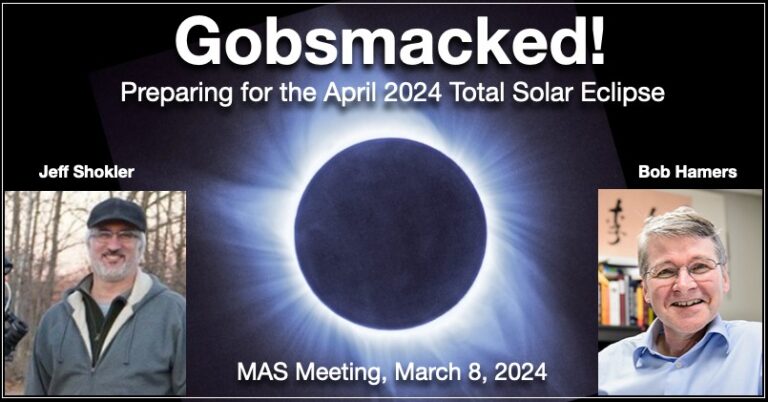
  • The April 2024 Total Solar Eclipse: Prepare to be Gobsmacked!

    Friday March 8, 2024, 7:00pm – UW Space Place

    Bob Hamers and Jeff Shokler will help you prepare for your total eclipse experience by sharing the insights, tips, and lessons learned from their own eclipse experiences. During the talk, they’ll help you consider your eclipse viewing and/or imaging goals, discuss the many ways one can enjoy experiencing a total solar eclipse (including the numerous phenomena to keep an eye out for), and share important safety considerations.

    If photographing the eclipse is one of your goals, they’ll also talk about the kinds of imaging gear that is most appropriate for photographing total eclipses, and how to plan and prepare for taking pictures – particularly under the demanding, tight timelines total eclipses present imagers. It’s not easy managing photographic gear while you’re totally gobsmacked by the sight of a total solar eclipse! Planning and preparation are the keys to success after your brain shuts down, and you’re witnessing one of nature’s most remarkable events!

    Bob Hamers is a spectroscopist and chemistry professor at UW-Madison. He has been a member of the MAS since 2017 and enjoys a mix of DSO, planetary, and solar imaging.

    Jeff Shokler is the Director for Technology and Assessment in the Office of Academic and Career Success at UW-Madison, serving in this role since November of 2012. Previously, he worked for fifteen years in the L&S Honors Program – nine as its Associate Director. His educational background is in anthropology, archaeology, and geoscience from Southern Methodist University in Dallas, TX, and the University of Wisconsin-Madison. A long-time amateur astronomer (dating back to his childhood in Texas) and now astrophotographer, Jeff joined MAS in 2004 and served for 15 years on its Board as President, Vice President, and Board Member-at-Large. He enjoys doing science and astronomy outreach at events like “Moon Over Monona Terrace,” star parties at Devil’s Lake State Park and Donald Park. Jeff often gives public presentations about astronomy and astrophotography at MAS monthly meetings, photography groups, school science classes, and senior living communities.

    Eclipse photo courtesy Jeff Shokler, August 2017.

    This meeting will take place in person at our usual Space Place classroom location. It will also be streamed live to our YouTube channel at https://www.youtube.com/@madisonastronomicalsociety.
  • Chasing ghost particles: searching for neutrinos from high-energy sources in real time.

    Friday February 9, 2024, 7:00pm – UW Space Place

    Neutrinos are tiny, nearly massless particles that interact very rarely. Because of this, astrophysical neutrinos can travel very far, all the way to the South Pole, carrying information directly from their sources. The IceCube Neutrino Observatory has detected these astrophysical neutrinos, but only a few sources have been identified thus far. We search for these neutrinos from transient sources – sources that vary in their brightness over time, such as gamma-ray bursts (GRBs), supernovae, novae, or mergers of compact objects. These sources often have very energetic processes happening inside them to accelerate particles and produce these neutrinos. By searching for these transient sources as they’re happening (in real time), we can inform follow-up by other observatories also searching for them, and better understand the nature of some of the highest energy phenomena in our universe.

    Jessie Thwaites is a 4th year graduate student in the UW—Madison Physics department, working with Justin Vandenbroucke on the IceCube Neutrino Observatory. Their research focuses on searching for high energy astrophysical sources of neutrinos from transient sources, in both real time and archival data. In addition to research, Jessie writes for Astrobites, a daily science communication blog that summarizes astronomy or astrophysics papers into bite-sized pieces for the public. Outside of physics, Jessie plays horn and enjoys hanging out with their cat, Ryan.

    This meeting will take place in-person at our usual Space Place classroom location. It will also be streamed live to our YouTube channel at https://www.youtube.com/@madisonastronomicalsociety

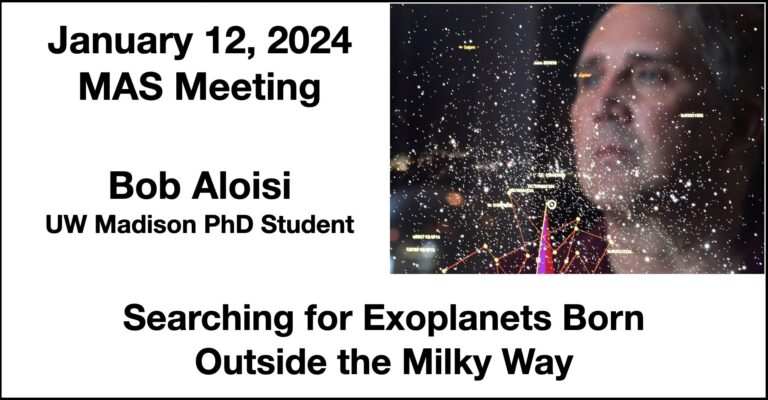
  • Searching for Exoplanets Born Outside the Milky Way

    Friday January 12, 2024, 7:00pm – UW Space Place

    Over 5500 exoplanets have been found orbiting stars in the Milky Way, with projections that most stars host planets. This poses the question of whether planets also exist orbiting the remnant stars of smaller dwarf galaxies that merged with the Milky Way, and if so, how do they differ from their Milky Way counterparts? VOYAGERS Views of Yore – Ancient Gaia-Enceladus Exoplanet Revealing Survey is a radial velocity search using precision spectrographs to find exoplanets orbiting low metallicity ([Fe/H] from -2.8 to -0.x, Vmag 8 to 10 stars born in the dwarf galaxy Enceladus, which merged with the Milky Way galaxy about 10 Gyr ago. A pool of 22 candidates from Enceladus F, G, and K class stars have been screened using reconnaissance observations from the TRES spectrograph. Precision RV measurements are ongoing over 3 years using the NEID, HARPS-N and CARMENES spectrographs. Ultimately, we hope the survey will lead to a better understanding of when and where in our universe’s history planets – and life – can form.

    Bob Aloisi is a 4th year Ph.D. student at the UW Madison. His return to graduate school follows a nearly 30 year career working in consumer products development. Bob’s work on exoplanets makes use of local telescopes such as the Bell Burnell Observatory at Promega, formerly the MAS Oscar Mayer Observatory, formerly the UW Madison Student Observatory.

    DUE TO SEVERE WINTER WEATHER THIS PRESENTATION WILL BE VIRTUAL VIA ZOOM.

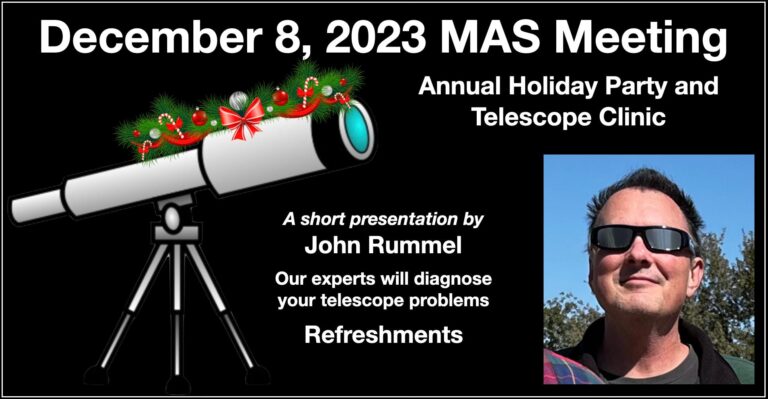
  • Annual Holiday Party and Telescope Clinic

    Friday December 8, 2023, 7:00pm – UW Space Place

    So You Want To Buy a Telescope?

    There will be a short (15-minute) presentation by John Rummel, former president and current historian of the Madison Astronomical Society:

    Do you have a telescope that’s giving you problems? Has it been gathering dust in your closet instead of giving great views of the moon and planets? Are you stuck and can’t get to the next step? Our experts can help you diagnose the issues and get it figured out. Bring your telescope to this meeting and we’ll take a look at it with you.

    Also, feel free to bring a holiday snack to share with the group. Cookies, brownies, or similar finger foods are preferred for minimal cleanup.

    This meeting will take place in-person at our usual Space Place classroom location. It will also be streamed live to our YouTube channel at https://www.youtube.com/@madisonastronomicalsociety.
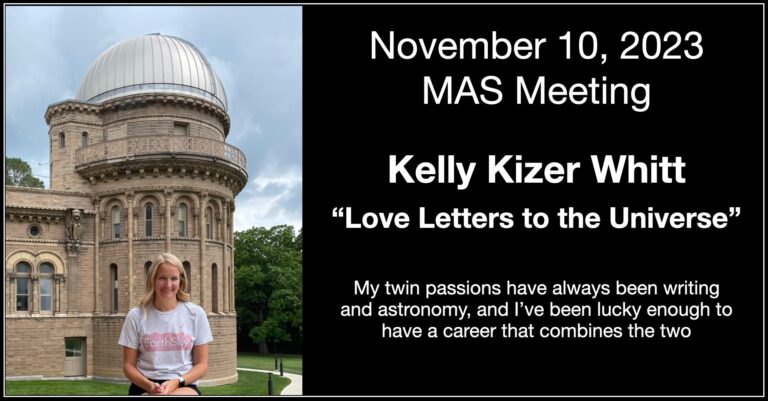
  • Love Letters to the Universe

    November 10, 2023, 7:00pm – UW Space Place

    “My twin passions have always been writing and astronomy, and I’ve been lucky enough to have a career that combines the two. As a science journalist, I focus on astronomy and earth topics, and as an author, some of my books center on space. I will talk about the path of my career and how I branched off into creative endeavors and also share some of my writing.”

    Kelly Kizer Whitt has been a science writer specializing in astronomy for more than two decades. She began her career at Astronomy Magazine and is currently a writer and editor at EarthSky.org. She’s also an author of nine books, including a children’s picture book, Solar System Forecast, and a young adult dystopian novel, A Different Sky.

    This meeting will take place in-person at our usual Space Place classroom location. It will also be streamed live to our Youtube channel at https://www.youtube.com/@madisonastronomicalsociety.
  • Moon Over Monona Terrace

    Friday October 20, 2023, 7:00pm-9:30pm – Monona Terrace Conference Center

    FREE and Open to the Public

    For more information, and to get your FREE tickets, visit: https://www.mononaterrace.com/event-group/moonmononaterrace/

    FREE ticket required for admission. Tickets are required for all attendees; subject to venue capacity and are issued on a first come first serve basis. There is a limit of 8 tickets per patron.

    Explore the surface of the Moon and other celestial objects through telescopes provided by MAS members.

    Young and old alike are invited to view the Moon and other celestial objects, such as Jupiter and Saturn, through a multitude of different telescopes provided by the Madison Astronomical Society (MAS). Activities include short kid-friendly presentations about the moon and other celestial phenomena, plus a kids’ fun zone with educational games and prizes!

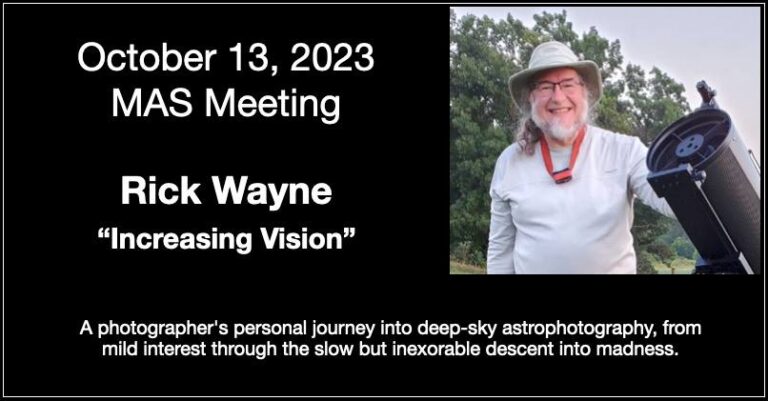
  • Increasing Vision

    Friday October 13, 2023, 7:00pm – UW Space Place

    A photographer’s personal journey into deep-sky astrophotography, from mild interest through the slow but inexorable descent into madness. Lessons learned. Pitfalls explored (from the bottom). Equipment choices, techniques and resources for beginners: how to put a toe in the deep-sky or planetary waters and avoid most of the piranhas.


    Rick Wayne is a husband, a dad, and a software engineer for UW Soils, where he writes agronomic decision-support software (motto: “Sweet Bog where do I put all these tons of cow poop?”)

    He is an Outdoor Emergency Care instructor and runs the regional instructor-development program for the Ski Patrol, and holds National Appointment #11910. His lifelong interest in photography led to his education (though not to his employment) as a photojournalist. He sort of toppled into deep-sky astrophotography on the way to something else.

    This meeting will take place in-person at our usual Space Place classroom location. It will also be streamed live to our Youtube channel at https://www.youtube.com/@madisonastronomicalsociety.
  • Why Solar Eclipses Matter and Why Totality Matters More Than Anything

    Friday September 8, 2023, 7:00pm – UW Space Place

    There are two important solar eclipse events coming up: the October 14 2023 Annular Solar Eclipse, and the April 8 2024 Total Solar Eclipse. This talk will be a general introduction to solar eclipses with a quick look back at the August 2017 event (seen by many MAS members) but a thorough look ahead to the two upcoming events. Why should you care and how should you prepare? Everything you need to know about planning for and then observing these two events will be covered.

    John Rummel is a long-time member and past president of the Madison Astronomical Society. He made his reservations for a place to stay in Texas nearly 3 years ahead of the April 2024 total eclipse!

    This meeting will take place in-person at our usual Space Place classroom location. It will also be streamed live to our Youtube channel at https://www.youtube.com/@madisonastronomicalsociety.
  • The James Webb Space Telescope Peers Back In Time 43 Minutes

    Friday August 11, 2023, 7:00pm – UW Space Place

    Though we may think of the James Webb Space Telescope (JWST) as primarily intended to observe the early universe and the most distant galaxies, it also counts observing bodies in our own solar system as part of its mission. As part of JWST’s Early Release Science program, a group of astronomers and planetary scientists proposed and and was selected to observe the Jupiter system, including its atmosphere, rings, and several satellites. Many of that progam’s observations have now been completed and results are being published. This talk will discuss the capabilities of several of JWST’s instruments including the Near Infrared Camera (NIRCam), Near Infrared Spectrograph (NIRSpec) and Mid Infrared Instrument (MIRI), and what observations they conducted. (Jupiter image processing by Ricardo Hueso and Judy Schmidt.)

    Dr. Pat Fry is a researcher at UW-Madison’s Space Science and Engineering Center. During his career, he has acquired, processed, and analyzed solar system data from the Galileo Probe’s Net Flux Radiometer, Hubble’s series of visible and near infrared cameras, Cassini’s imaging camera and imaging spectrograph, as well as conducting observations of Jupiter, Uranus, and Neptune at NASA’s Infrared Telescope Facility (IRTF) and the Keck Observatory on Hawaii’s Mauna Kea mountaintop.

    This meeting will take place in-person at our usual Space Place classroom location. It will also be streamed live to our Youtube channel at https://www.youtube.com/@madisonastronomicalsociety.