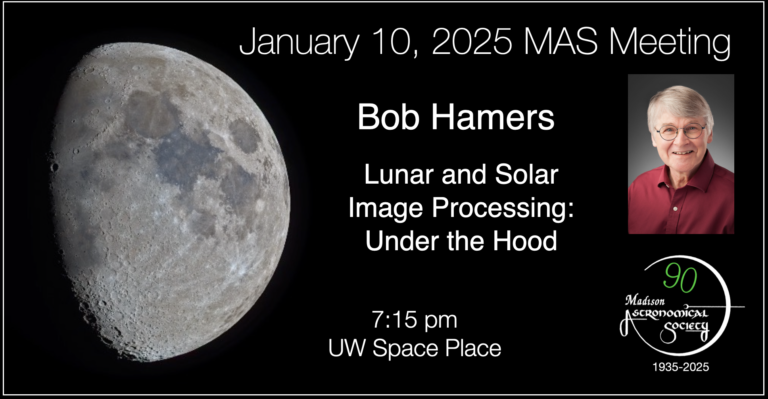
• Lunar and Solar Image Processing: Under the Hood

    Friday January 10, 2025, 7:00pm – UW Space Place

    At the January 10, 2025 MAS meeting, member Bob Hamers will give a special talk titled:

    While commercial programs do a good job of processing most images. To get the very best result, it can be helpful to use additional tools to analyze, process, and visualize the process. In this talk, I’ll discuss some of the challenges of solar and lunar image processing and demonstrate some freeware tools that can be used to help get the most out of your data. As examples, I’ll walk through the processing of high-resolution, full-disc RGB imaging of the Moon and continuum imaging of the Sun, and I’ll briefly introduce the freeware tools ImageJ and Python.

    Bob Hamers is a UW-Madison Professor of Chemistry and MAS member. His UW research centers on chemical and structural analysis of solids and their surfaces. Bob’s astrophotography interests include solar, lunar, and DSO imaging. This meeting will take place in-person at our usual Space Place classroom location. It will also be streamed live to our Youtube channel at https://www.youtube.com/@madisonastronomicalsociety.

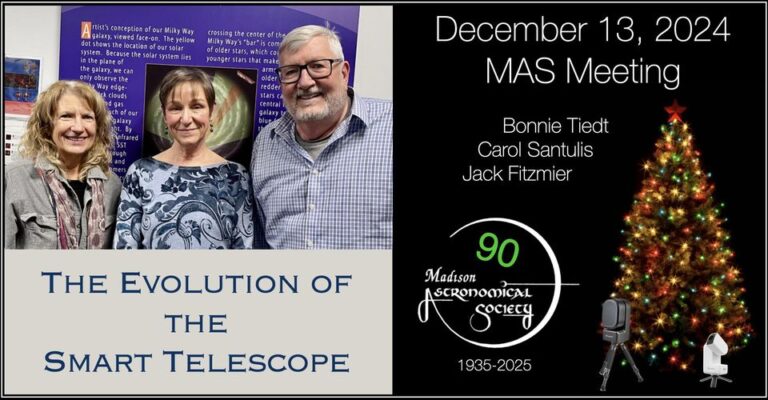
  • The Evolution of the Smart Telescope

    Friday December 13, 2024, 7:00pm – UW Space Place

    A special presentation by MAS members Jack Fitzmier, Bonnie Tiedt, and Carol Santulis.

    Recent smart telescopes are an evolutionary advancement in astrophotography yielding unprecedented ease of use. This is a three-part discussion about the advent and significance of the SeeStar technology among amateur astronomers. Jack will explore how new technologies have transformed amateur astronomy in the last 15 years, setting the stage for smart telescopes. Bonnie will discuss the SeeStar’s “out of the box” ease of use, and Carol will present more advanced aspects of the technology.

    This meeting doubles as our Solstice Celebration. Feel free to bring a holiday snack to share with the group. Cookies, brownies, or similar finger foods are preferred for minimal cleanup.

    This meeting will take place in-person at our usual Space Place classroom location. It will also be streamed live to our Youtube channel at https://www.youtube.com/@madisonastronomicalsociety.

  • Astronomy Instrumentation and Detectors

    Friday November 8, 2024, 7:00pm – UW Space Place

    Description: Astronomers rely on scientific instruments to get good quality data to explore the unresolved questions about our universe. One way to get better data is to improve our scientific instrumentation. This is what makes new instruments like the James Webb Space Telescope so exciting. I will discuss some of the technological advancements in some popular science instruments and also talk about my research on next generation X-ray detectors.

    Bio: My name is Miriam Marino (she/her) and I am a third year PhD student at UW-Madison in the Astronomy department. I work in Professor Dan McCammon’s research group and my research focus on fabrication next generation high energy resolution X-ray detectors for space based applications. Outside of work I like to play ultimate frisbee, hike, run, bike and read.

    This meeting will take place in person at our usual Space Place classroom location. It will also be streamed live to our YouTube channel at https://www.youtube.com/@madisonastronomicalsociety.

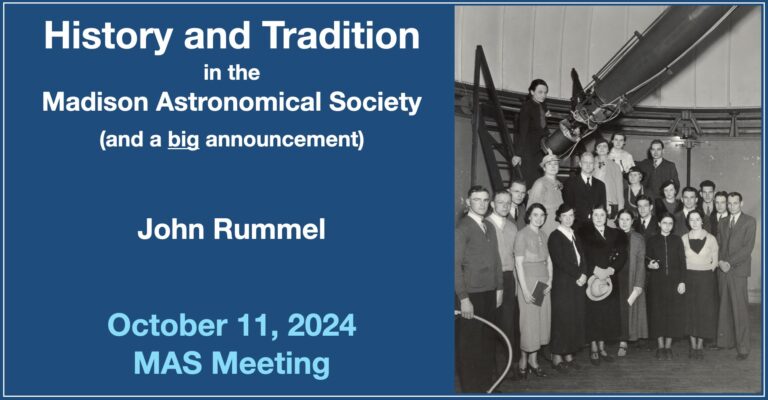
  • History and Tradition in the MAS

    Friday October 11, 2024, 7:00pm – UW Space Place

    In 1990-91, the Madison Astronomical Society confidently celebrated its 60th anniversary with a slate of special events and public outreach. Everyone knew that the club had formed in 1930. That had been the conventional wisdom for decades and there appeared to be documentary evidence to back it up. But conventional wisdom is not always wise and mistakes do happen. What IS the club’s actual birthdate?

    Anniversaries, birthdays and other traditions are important. Honoring the past preserves those traditions and helps us focus on who we are and where we’re headed. MAS anniversaries and traditions are meaningful and we’re fortunate that much of our story has been preserved. We’ll honor a few of those traditions at this meeting and spend a little time probing the origins of our club and the ways early members celebrated its founding and continued existence. We’ll also make a special announcement about the revival of a tradition that you won’t want to miss.

    This meeting will take place in person at our usual Space Place classroom location. It will also be streamed live to our YouTube channel at https://www.youtube.com/@madisonastronomicalsociety.

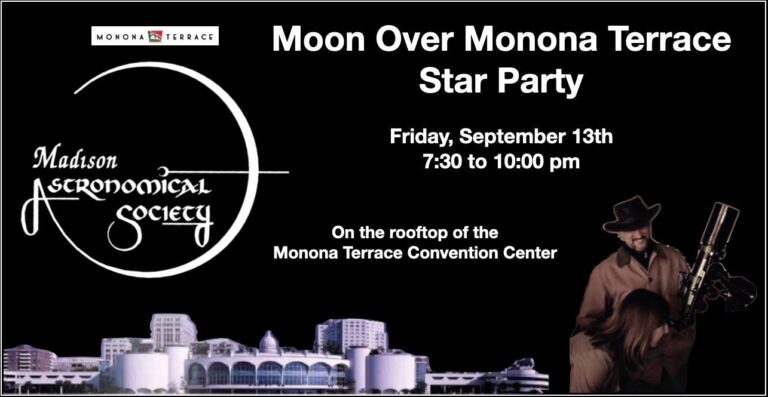
  • Moon Over Monona Terrace

    Friday September 13, 2024, 7:30pm – 10:00pm – Monona Terrace Convention Center

    2024 Moon Over Monona Terrace is on September 13th

    What: One of the biggest star parties in the US
    When: Friday, September 13th, 7:30 to 10:00 pm
    Where: Monona Terrace Convention Center (rooftop)

    MAS will have multiple telescopes, binoculars and other instruments set up so members of the public can explore the moon and other celestial objects.

    Free and open to the public but tickets are required for admission. Visit https://www.mononaterrace.com/event-group/moonmononaterrace to get tickets.

  • MAS Member Discussion Roundtable

    Friday September 6, 2024, 7:00pm – UW Space Place

    Due to a conflict created by our Moon Over Monona Terrace star party on Sept. 13th, the regular September monthly meeting will take place on Friday, September 6th. There will be no guest speaker presentation at this meeting. Rather, we will have a moderated discussion among all those present. Topics can include:

    Preparing for a large public event: Our upcoming “Moon Over Monona Terrace” event is one of the largest star parties in the midwest. Are you ready for hundreds of people wanting to look through your telescope?

    Back in the Astronomical League: MAS recently rejoined the AL 30 years after quitting. Do you have thoughts?

    Welcome of new members and visitors: have you only recently joined the MAS? This is a chance for us to meet new members and visitors (and get your questions answered!).

    Other topics – as raised by attendees at the meeting – will be discussed as time permits.

    This meeting will take place in person at our usual Space Place classroom location. It will also be streamed live to our YouTube channel at https://www.youtube.com/@madisonastronomicalsociety
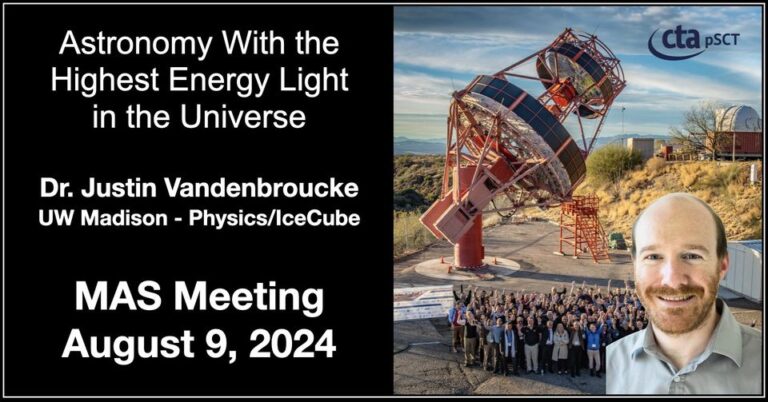
  • Astronomy With the Highest Energy Light in the Universe

    Friday August 9, 2024, 7:00pm – UW Space Place

    Major breakthroughs have been made in astronomy by expanding observations to far longer and far shorter wavelengths than we can see with our eyes. The shortest-wavelength photons are gamma rays, the highest energy photons in the Universe. Some of these photons are trillions of times more energetic than the human eye can detect. There is a surprising variety of astronomical sources glowing or flashing in these very-high-energy gamma rays. They are powered by some of the most extreme objects in the Universe: exploding stars, white dwarfs, neutron stars, and black holes. I will describe the science that very-high-energy gamma rays enable and the prospects for the Cherenkov Telescope Array Observatory, an international project currently under construction.

    Justin Vandenbroucke is an associate professor at the University of Wisconsin–Madison, in the Physics Department and Wisconsin IceCube Particle Astrophysics Center. His research focuses on gamma-ray astronomy with the Cherenkov Telescope Array Observatory, neutrino astronomy with the IceCube Neutrino Observatory, and citizen science with the Distributed Electronic Cosmic-Ray Observatory. Vandenbroucke obtained his PhD in Physics from UC-Berkeley and held postdoctoral positions as a Kavli Fellow at Stanford University and NASA Einstein Fellow at SLAC National Accelerator Laboratory. Vandenbroucke is currently a UW–Madison Vilas Associate.

    This meeting will take place in person at our usual Space Place classroom location. It will also be streamed live to our YouTube channel at https://www.youtube.com/@madisonastronomicalsociety.

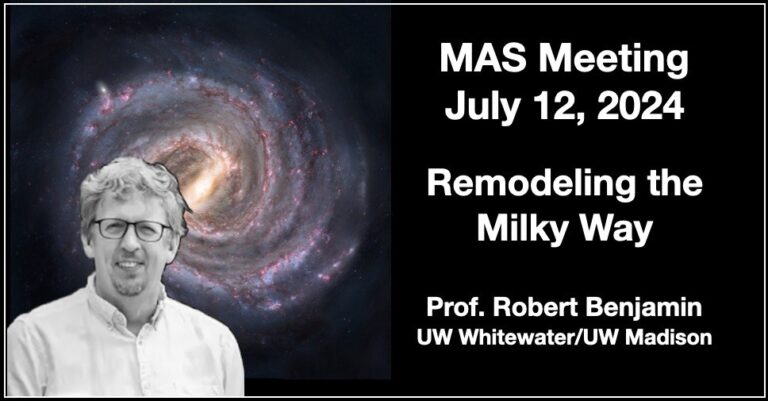
  • Remodeling the Milky Way

    Friday July 12, 2024, 7:00pm – UW Space Place

    Thanks to high precision stellar distances and velocities obtained with the European Space Agency mission Gaia, astronomers are doing all sorts of Milky Way investigations that I personally never imagined would be possible. From identifying the ingredients that first formed the Milky Way, to unscrambling the young clusters around the Sun back to their point(s) of origin 40 million years ago to building highly accurate three-dimensional maps of the interstellar medium, we are in a Golden Age for Galactic astronomers. I will share some of these advances, how they are unravelling our old picture of the Milky Way, and pointing the path to something better.

    If you’re interested in some background before the talk, check out the recent article about Bob’s research in Scientific American: https://www.scientificamerican.com/article/the-new-story-of-the-milky-ways-surprisingly-turbulent-past/

    Prof. Benjamin obtained his PhD at the University of Texas at Austin in 1994 and has been a professor of physics at the University of Wisconsin-Whitewater since 2003. Although he is about to retire from his position at UW-W this August to provide home care for his mother, he plans to continue his research on the Milky Way as a professor emeritus and is looking forward to the launch of two upcoming NASA missions: SPHEREx (2025) and Roman (2027).

    This meeting will take place in person at our usual Space Place classroom location. It will also be streamed live to our YouTube channel at https://www.youtube.com/@madisonastronomicalsociety.

  • Three Myths of Science Education

    Friday June 14, 2024, 7:00pm – UW Space Place

    Few people question the importance of science education in American schooling. It’s the key, after all, to economic growth, develops the ability to reason more effectively, and enables us to solve everyday problems. Good science teaching results in all these benefits and more—or so we think. But what if all this is simply wrong? What if the benefits we assume science education produces turn out to be an illusion, nothing more than wishful thinking? In this talk, Rudolph will examine the reasons we’ve long given for teaching science and assesses how they hold up to what we know about what students really learn in science classrooms and what research tells us about how people actually interact with science in their daily lives. The results may be surprising. Instead of more and more rigorous traditional science education to fill the STEM pipeline, Rudolph will challenge us to think outside the box of traditional instruction and make the case for an expansive science education aimed instead at rebuilding trust between science and the public—something desperately needed in our current era of impending natural challenges and science denial


    John L. Rudolph is the Vilas Distinguished Achievement Professor of Science Education at the University of Wisconsin-Madison. His main area of research focuses on the history of science education in American high schools. He also writes about issues related to the nature of science in the present-day school curriculum and on how the history, philosophy, and sociology of science have been used in science education research. He received his Ph.D. from the University of Wisconsin-Madison in curriculum and instruction and history of science. Prior to his current appointment, he spent a number of years teaching physics, chemistry, and biology in middle schools and high schools across Wisconsin. He is past editor-in-chief of the Wiley & Sons journal Science Education and a National Academy of Education/Spencer Postdoctoral Fellow.

    This meeting will take place in person at our usual Space Place classroom location. It will also be streamed live to our YouTube channel at https://www.youtube.com/@madisonastronomicalsociety.

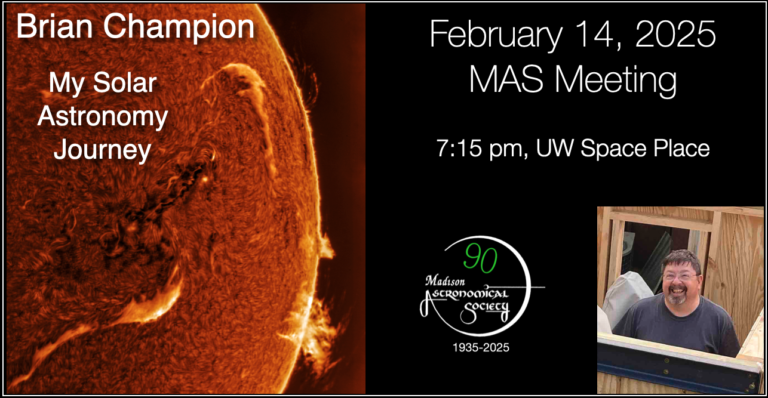
  • A Window to the Universe in My Backyard….

    Friday May 10, 2024, 7:00pm – UW Space Place

    Having a backyard observatory is like having my own window to the universe. Any clear night I can roll the roof back and marvel at all the wonders available to see.

    Having a backyard observatory means not having to spend time setting up or breaking down my equipment. I can be ready to start imaging in just a few minutes and in the morning; just roll the roof closed and I can head off to work.

    I designed my observatory with Shapr3D on my iPad. I looked at many different designs and chose the most useful features for my own needs.

    Brian’s biographical sketch:

    My astrophotography journey started a little over 25 years ago as an extension of my photography hobby. I got interested after attending a public viewing put on by the Starsplitters in Wyalusing State Park, a group I currently belong to. I got to see a few of the planets and several star clusters. I got pretty interested and started looking for a telescope. My first was a 10” Meade LX200. I shot with that scope for several years, but I found myself losing interest because the scope was heavy and hard to set up. Fast forward to the ’17 solar eclipse. At the eclipse, I got to look through a solar hydrogen alpha telescope, and my interest was reinvigorated. My main interests in astrophotography are nebulae and solar.

    For the last 20-plus years, I’ve worked as a manufacturing engineer for a small local company. They make plastic under the hood engine parts for all the major OEM’s. My focus there is automation, machine vision, robots, and injection molding. Outside of work, my hobbies include photography and woodworking.

    This meeting will take place in person at our usual Space Place classroom location. It will also be streamed live to our YouTube channel at https://www.youtube.com/@madisonastronomicalsociety