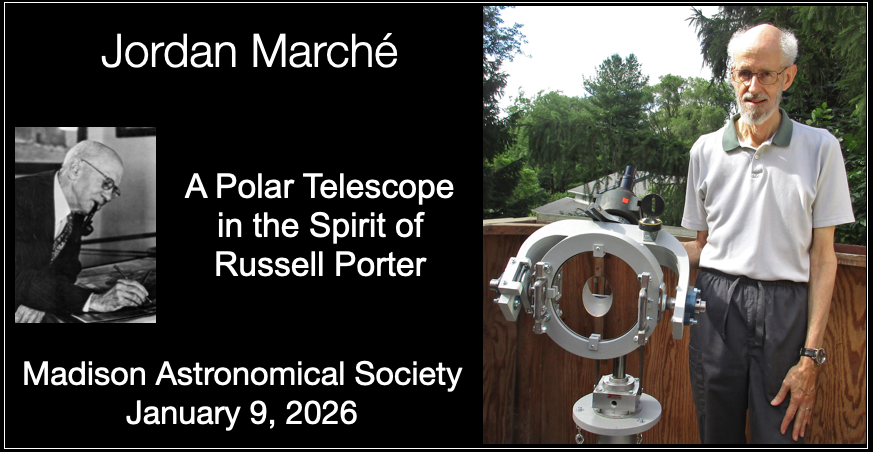
The design for this unusual telescope, which features a polar-aligned, fixed eyepiece, takes me back several decades. At the time, I was investigating warmed-room observatories, many of which had been featured in the well-known Amateur Telescope Making book series (three volumes). One of the simplest of these had been constructed by Russell W. Porter (1871–1949), principal founder of the amateur telescope making movement, which (in the U.S.) began in the early twentieth century.
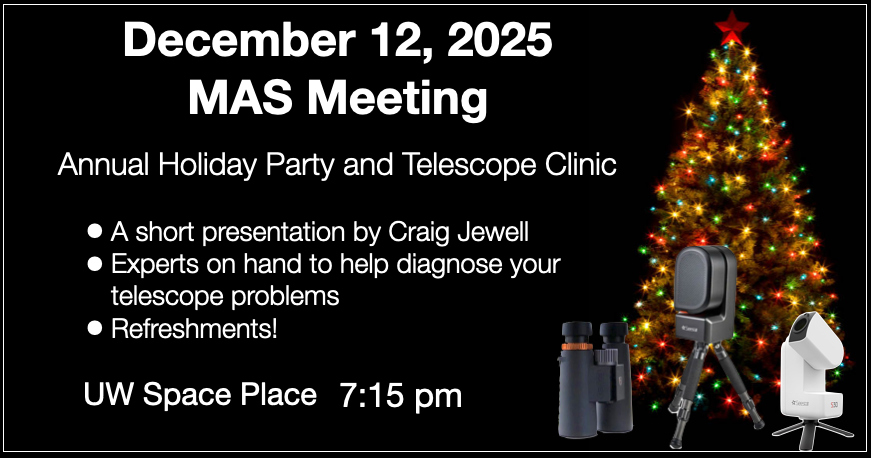
Our December meeting is our annual “telescope clinic” where we invite anyone to bring their troublesome or confusing telescopes to the meeting. Our members will assist you in understanding how they work and diagnosing (and even fixing) any problems you’ve encountered. Also, refreshments!
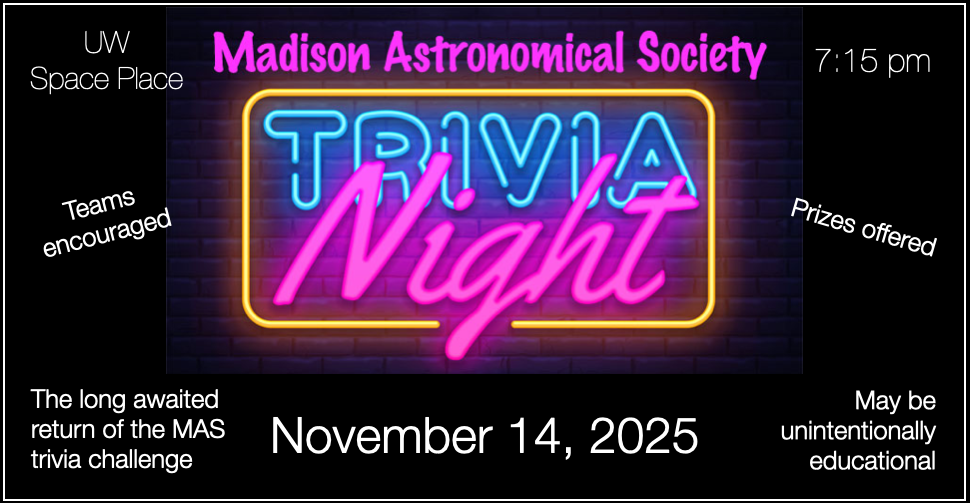
The November monthly MAS meeting will feature the long-awaited return of the MAS Trivia Contest! Test your knowledge of astronomy and nerd trivia. Have a fun time with old and new friends. Win prizes! Gain bragging rights!
Kevin Santulis and John Rummel will be your trivia hosts.
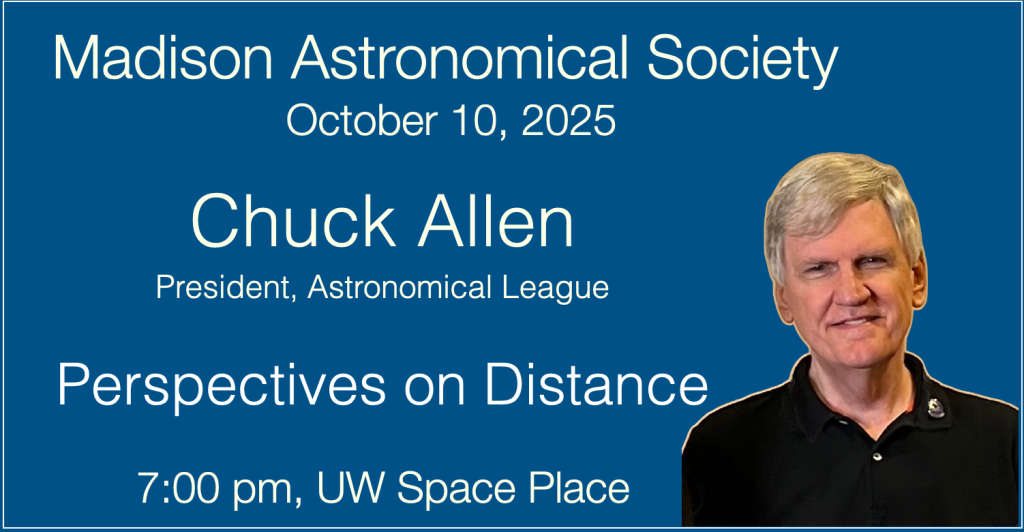
“Perspectives” examines relative distances in the universe and the possible distances achievable through manned and unmanned space flight and through amateur and professional telescopic observation. Examining scales from the human altitude record to the four cosmological horizons, the program discusses astrophysicists’ current thinking about several significant questions:
Friday September 12, 2025, 7:00pm – UW Space Place
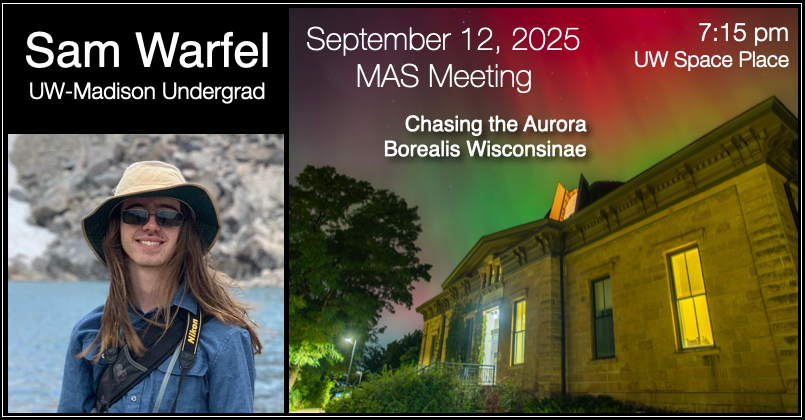
Seeing the Aurora Borealis is a bucket-list item for many. I’ll tell my story of how I learned about and finally saw the aurora here in Wisconsin, and share some tips tidbits I’ve picked up that can help you see and capture it too, whether it’s your first time or one of many.
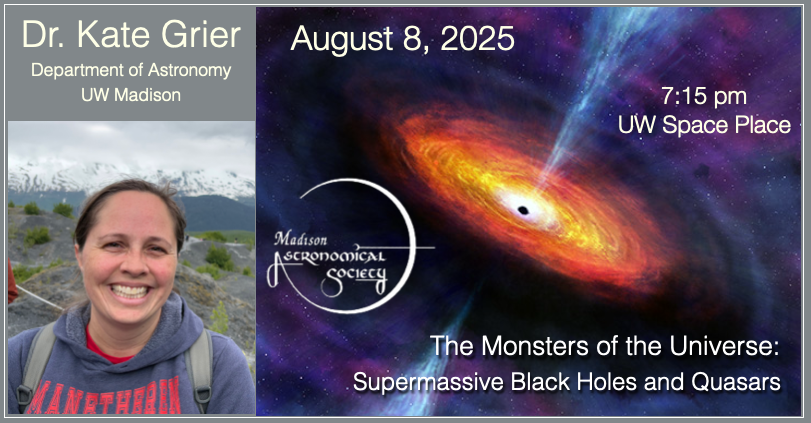
Supermassive black holes, with masses that range from tens of thousands to billions of times the mass of our Sun, are thought to be present in every galaxy in the Universe and can affect the growth and evolution of these galaxies. In order to understand how galaxies evolve, we must therefore understand the role played by supermassive black holes.
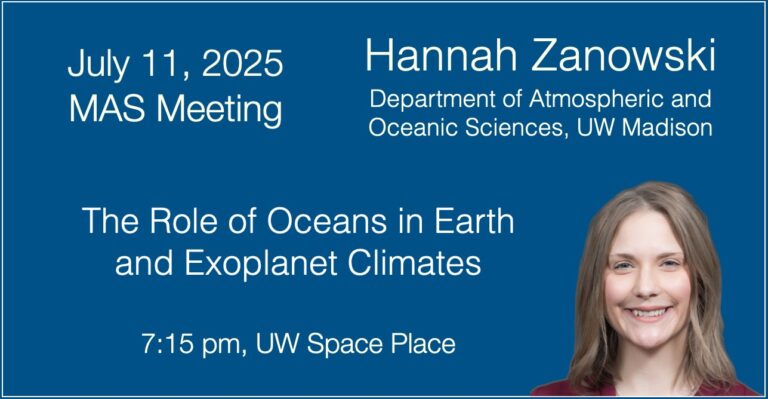
Earth has had an ocean for more than 4 billion years. It likely formed sometime after the beginning of the Hadean Eon (4.6-4 billion years ago) via mantle degassing as the planet cooled. Although we know significantly more about the modern ocean than we do about its deepest past, an ever-growing body of research suggests that the key to understanding the origin and evolution of life on our planet, and perhaps planets elsewhere, may well be hidden in the ocean’s physical and chemical complexities. In this talk, I will give a broad overview of the fundamental role the ocean plays—and has played—in Earth’s history, from the evolution of early life to the climate we know today. In doing so, I will provide a crash course in physical oceanography, and I will draw from this body of knowledge, as well as recent research in my lab, to help us understand how oceans could behave on exoplanets, including their role in modulating climate and habitability.
Dr. Hannah Zanowski is an assistant professor in the Department of Atmospheric and Oceanic Sciences (AOS) at UW-Madison. She earned her B.S. in physics and mathematics from the University of Arizona in 2011 and her Ph.D. in Atmospheric and Oceanic Sciences from Princeton University in late 2016. Zanowski uses climate models to do her research, which has three major focuses: present and future Arctic Ocean change, the physical oceanography of the Archean (4-2.5 billion years ago), and ocean circulation and heat transport on exoplanets. She is also the director of the STORM REU, a National Science Foundation (NSF)-funded undergraduate summer research program spearheaded by the AOS department in conjunction with the Center for Climatic Research (CCR), the Space Science and Engineering Center (SSEC) and the Cooperative Institute for Meteorological Satellite Studies (CIMSS). In her free time, Zanowski enjoys doing Muay Thai, spending time in the sun, and grossly overestimating how many native plants she really needs for her yard.
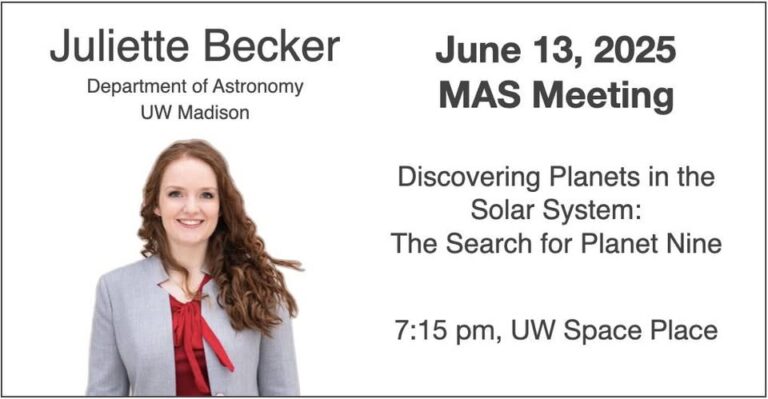
UW Astronomy professor Juliette Becker will give a special presentation titled: Discovering Planets in the Solar System: The Search for Planet Nine
In this talk, I will discuss the history of discovering planets in the solar system. After a brief historical context (on Uranus, Neptune, and Vulcan), I will discuss the current search for Planet Nine, the hypothetical as-yet-undiscovered ninth planet in our Solar System, thought to be about six times as massive as Earth and orbiting 600 times further away from the Sun than Earth does. I’ll discuss why scientists think it’s there, and what it might mean that no one has found it yet!
Biography: I am a professor in the Department of Astronomy at the University of Wisconsin. My research interests include planet formation – understanding why planets form, and why planetary systems look the way they do. Previous to joining the faculty at Wisconsin, I worked at Caltech with Konstantin Batygin (the person who, along with Mike Brown, first proposed the existence of Planet Nine in 2016).
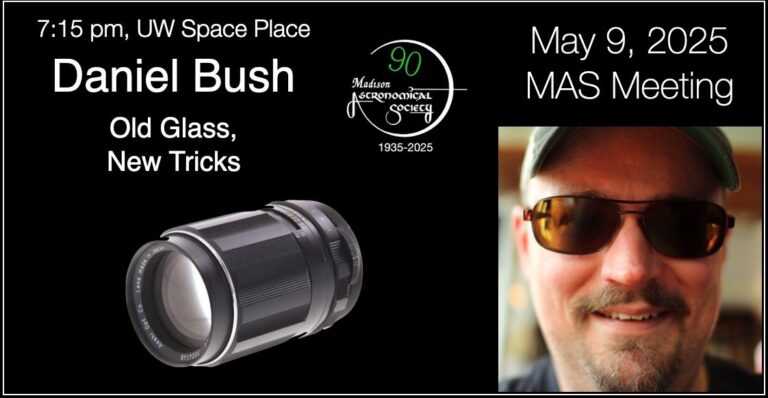
Digital sensors and image processing software have revolutionized astronomy and astrophotography, but we still depend as much as Galileo on collecting photons. In our world of cooled cameras and image stacking, how much do we need the latest and greatest telescopes? MAS member Dan Bush will share his results from a recent experiment in combining new and old technology to image a familiar target, and perhaps spark some ideas about taking advantage of your older gear!
Dan Bush is a recent astrophotography hobbyist and longtime astronomy enthusiast. Many years ago he was a physics/astronomy major, interning at the Space Telescope Science Institute and getting very sick on an observing trip to Kitt Peak. Eventually, his other interests and inability to grok differential equations led him down a different path. Dan lives on the Bortle 8 north side of Madison with his wife and 7th grader, whom he is dragging to Mount Palomar on their spring break trip to Southern California. He works as a Medicaid program manager for the Wisconsin Department of Health Services.
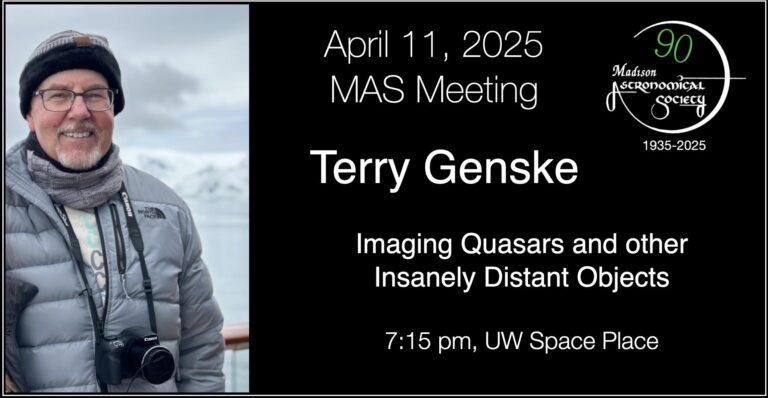
Have you ever wondered what lies beyond the visible night sky? I want to take you on a tour of some of the more distant and enigmatic objects in the known universe including quasars, blazars, black holes, and other extreme objects. I will also discuss the equipment, process and challenges involved while attempting to image each of these objects.
Bio: My name is Terry Genske. I am member of the Madison Astronomical Society (MAS) and more recently, the Astronomical League through MAS. My wife and I live in a condo on the north side of Waunakee, WI. I have always loved looking up at the night sky, but only recently entered the world of astrophotography. I quickly became hooked on the thrill of capturing beautiful night-sky images from our suburban driveway.