Category: MAS-History-General-Post

  • Historical View: MAS Meeting Locations

    In 2026 the UW Space Place will close, and MAS will lose its home of nearly 30 years. In its 90+ year history, the club has moved around a bit. Here is a recap of most of the locations used by the club for monthly meetings. 

    1935-36, The Early Years

    After its formation in 1935, MAS relied on the resources of its members for meeting venues. Locations, for the most part, were members’ places of employment: The Madison Vocational School (later MATC), Madison General Hospital, the Forest Products Laboratory, and the Monona Golf Club clubhouse. Meetings generally took place on the third Wednesday of the month.

    1936-1960, The Washburn Observatory

    The Society’s deep connection with Dr. C. M. Huffer, professor of astronomy, led to an invitation for the club to use the classroom inside the Washburn Observatory for some of its regular meetings in late 1936. By the beginning of the 1937-38 academic year, that arrangement seems to have been finalized into a permanent home for the club. The only limitation was that the club’s use of the building not interfere with the Washburn tradition of public nights when the telescope and observatory were open to the public. Since those nights were (and still are) the 1st and 3rd Wednesday evenings, the club began meeting on the 2nd Wednesday of the month.

    1960-1970, Sterling Hall

    By the late 1950s, it was clear that Observatory Hill on the campus was no longer tenable for astronomical research. The city and campus had grown by leaps and bounds in the previous decades, virtually enveloping the Washburn Observatory in light pollution and smoky haze. In the fall of 1959, the Astronomy Department began moving most of their observing activities to their new observatory in Pine Bluff, WI, about 13 miles west of Madison. The department’s new digs on the top floor of Sterling Hall had abundant classroom space, and the department extended its relationship with MAS by allowing our meetings to take place there after Washburn transitioned to other purposes.

    1970-1980, The Wilderness Years

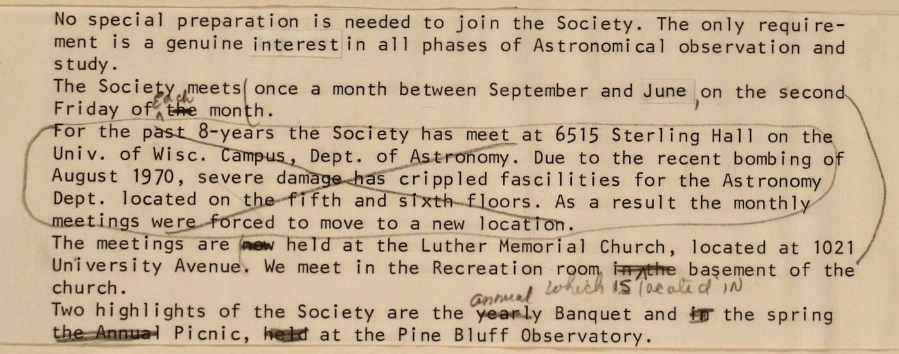
    Rough notes for the MAS newsletter circa 1971, noting the bombing of Sterling Hall.
    Editorial notes for an MAS newsletter in the aftermath of the Sterling Hall bombing.

    MAS’s use of Sterling Hall classroom space came to an abrupt end in August of 1970 when a bomb exploded just outside the building, extensively damaging Sterling Hall, and killing a graduate student. For the next two decades, MAS was somewhat nomadic again and met in a variety of locations. For a time immediately after the bombing, Luther Memorial Church on University Ave was used. The group seems to have met occasionally at its own Oscar Mayer Observatory on the Bjorksten property in Fitchburg (present-day Promega), but the observatory’s meeting room was tiny, and parking options were very limited. 

    1980-1993, The Bank Years

    Between 1980-84, the club secured space at the United Bank and Trust of Madison at 5574 Lacy Road.

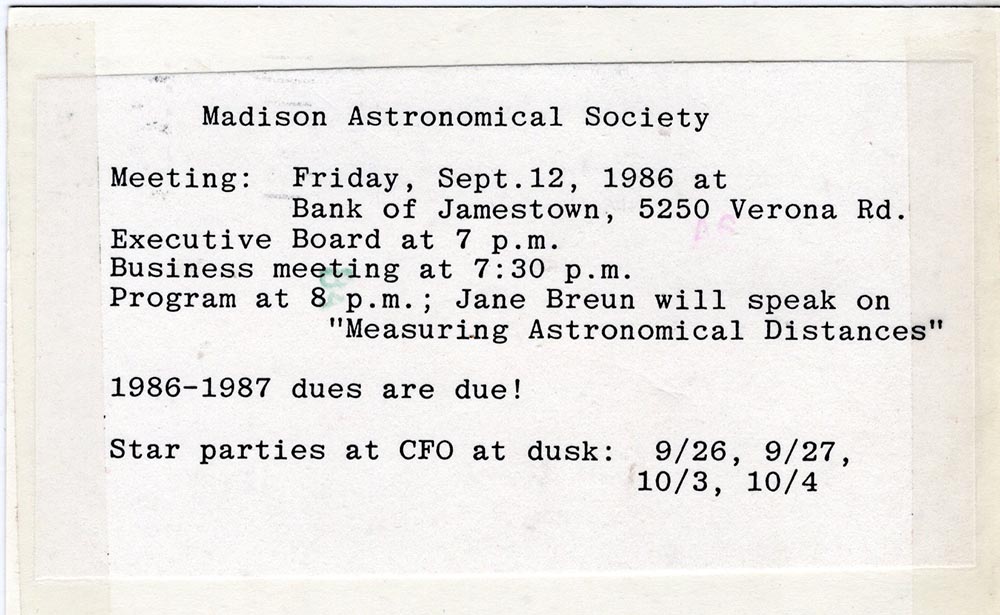
    MAS meeting announcement with Jamestown Bank as location

    In early 1984, we moved to the M&I Bank of Jamestown at 5250 Verona Rd (intersection of Williamsburg Way). This arrangement served the club until May of 1993. 

    1993-1996, Edgewood High School

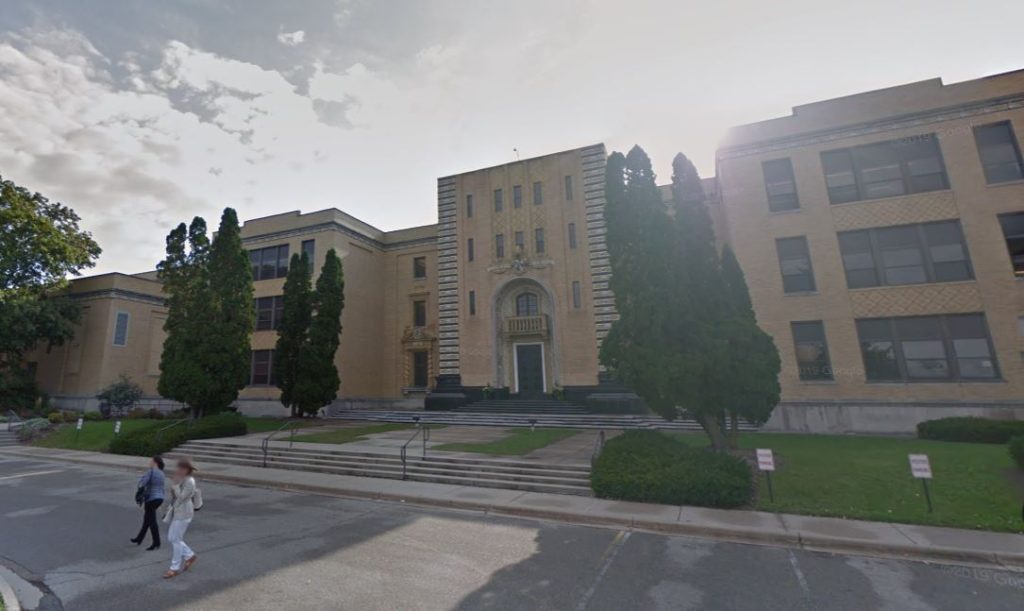
    From mid-1993 until 1996, the club met in a classroom at Edgewood High School on Monroe St. This space was made available by club secretary Bob Shannon, who taught chemistry there.

    Edgewood High School on Monroe St in Madison. Used for MAS meetings in the 90s.

    1996-2026, Space Place

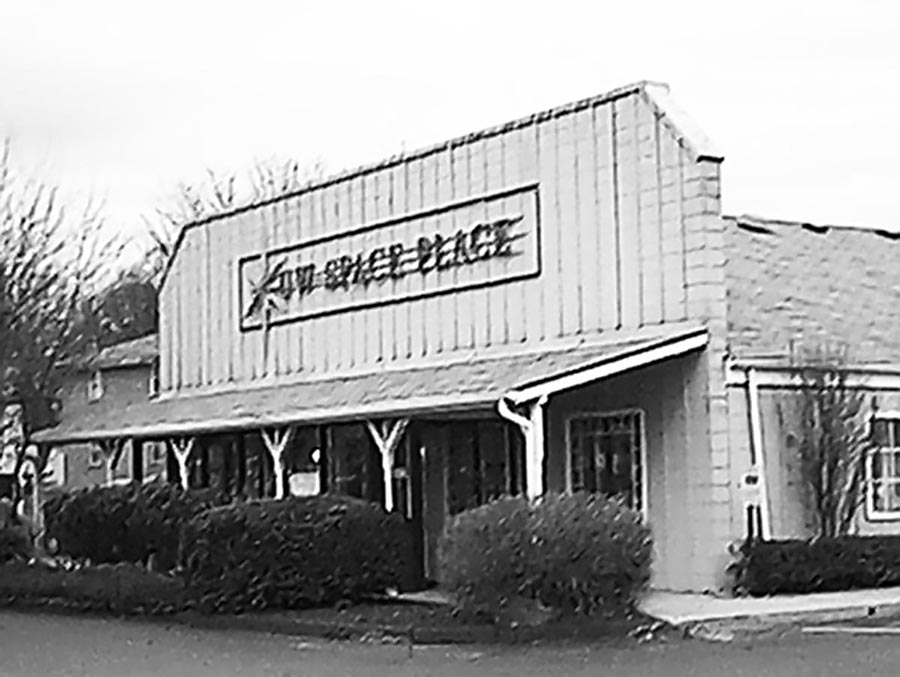
    Around 1990, even before the club had moved to Edgewood HS, the University Space Astronomy Lab (SAL) opened a new outreach facility called Space Place. To house the new facility, the UW leased the old Ponderosa Steakhouse at 1605 S. Park. The “old Space Place” housed a museum exhibit space highlighting the UW’s significant role in space and astronomy, and had a small meeting room in the back for SAL departmental outreach efforts. Though there was much cooperation and collaboration between MAS and Space Place (Jim Lattis assumed the directorship in 1995), nobody seems to have thought of Space Place as a permanent meeting location for the club until much later.

    The old Ponderosa Steakhouse building on Park St. Used for MAS meetings in the late 90s and early 2000s.

    Our first record of a regular meeting (not a joint outreach event) there was the annual holiday/solstice party in December of 1996. The first record I can find of a regular monthly meeting being held there is May of 1998, when UW physics professor Bernice Durand gave a talk on Einstein’s theory of relativity.

    I was at this meeting, but am pretty sure it was not the first time we used it for a regular monthly meeting. But I can find no records earlier than this one. (Our January 1998 newsletter notes that the March regular meeting would be held at a location TBA. There was no April 1998 meeting due to the banquet).

    In the summer of 2005, Space Place moved less than a mile south on Park St to its current location in the Villager Mall, and MAS moved along with it. The current location in the Villager has been our home for nearly 20 years, and the only MAS home most members have ever known.

    We’re going to miss it!

    (posted by John Rummel, December 2026)

    Back to More MAS History.

  • This Newsletter is Venerable

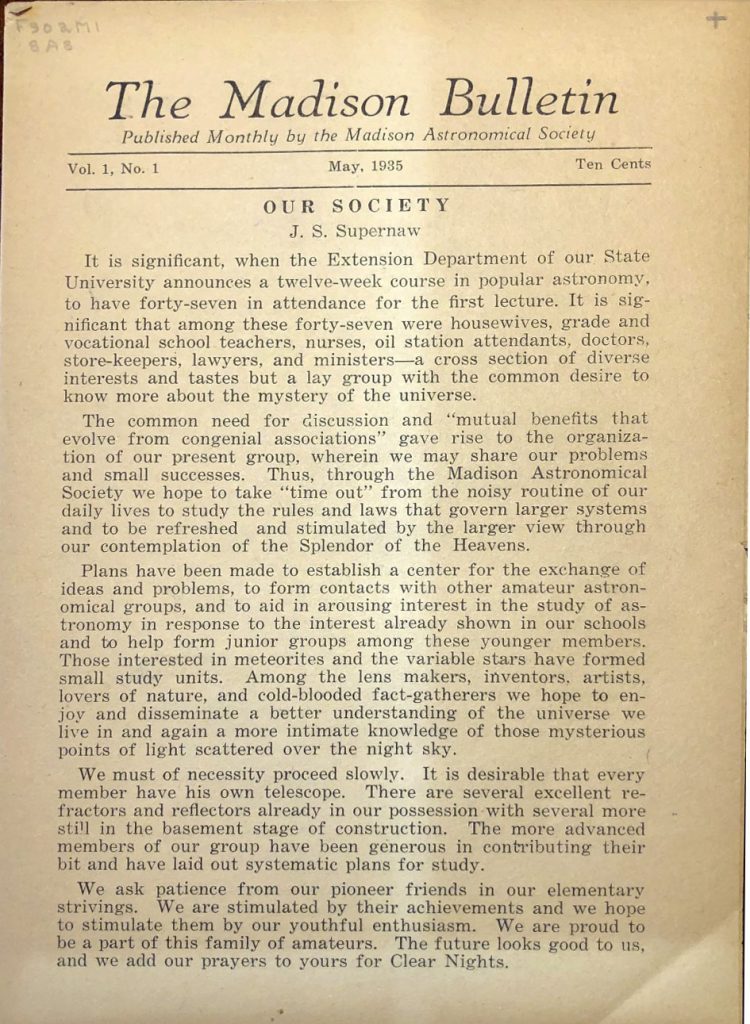
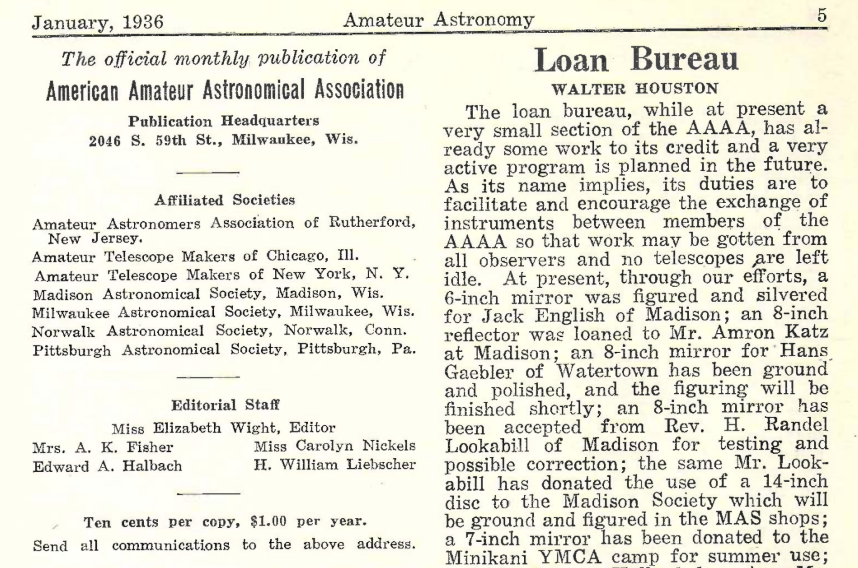
    As soon as the Madison Astronomical Society was officially formed in early 1935, one of the first things its founders did was establish a newsletter. They recognized the significance of communication with members, the ability to share information, and the creation of a lasting record that would recount the group’s story to future generations. The first page of the inaugural issue, as shown here, provides a brief overview of the group’s formation, which was inspired by an astronomy class offered at the UW Extension in early 1935.

    Cover image of the 1935 Madison Bulletin

    The very first newsletter of the MAS, published when the club was only a few months old. You can read the entire four-page issue here.

    Over the years, publishing a newsletter has been an integral part of the club’s activities. However, our records are incomplete, and many of those early newsletters may be lost forever. A comprehensive list of our archived newsletters is included below. All of these historical issues are now accessible in our historical archive (click here to view).

    MAS Newsletter Archives include:

    • Madison Bulletin, 1935: 8 issues
    • Amateur Astronomy, 1936-38: 13 issues (published by the American Amateur Astronomical Association, a precursor to the Astronomical League)
    • Star Trails, 1964-67: 9 issues (published by the Junior Astronomical Society of Madison, Wisconsin)
    • Armchair Astronomer, 1978-79 (published by the Explorer Scout troop, 2 issues)
    • Capitol Skies, 1976-2016: 100 issues (note: “Capitol Skies” was first used as the title in the November 1988 issue. Prior to that it was called “M.A.S. Newsletter,” “Monthly Letter,” and other various titles.
    • Capitol Skies, 2024-present: just 5 issues so far (as of September, 2025).

    In December 2024, Capitol Skies resumed its publication after a hiatus of nine years. Now a digital-only volume, the new Capitol Skies will join the existing lineup as the electronic continuation of the MAS publications record. Thanks to the leadership of Jack Fitzmier (with assistance from me and the other MAS members whose names can be found herein), the newsletter has been officially revived for a new generation.

    You can find all of the new electronic edition Capitol Skies at our newsletter page.

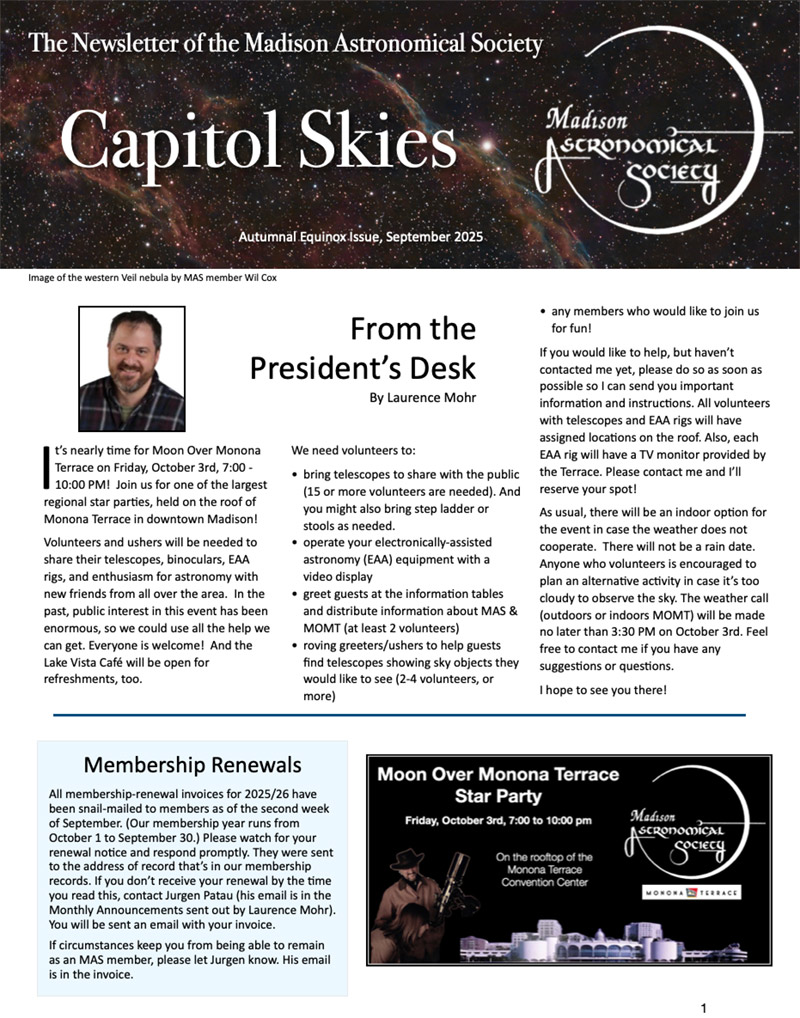
    CapSkies cover 9-2025
    Cover of the Fall Equinox issue of the Capitol Skies, 2025.

    (Posted by John Rummel, November, 2025).

    Back to More MAS History.

  • The Origins of Moon Over Monona Terrace

    The star/moon party on the rooftop of Monona Terrace Convention Center has been an essential event for MAS for nearly 30 years now. How did it get started?

    The origins of the Moon Over Monona Event go back to October 1998 when the American Astronomical Society’s Division of Planetary Sciences (AAS-DPS) held its annual convention in Madison. DPS is a Big Deal, attracting scientists from all over the world for the planetary science community’s biggest event. Hosting DPS in Madison was seen as a huge opportunity for the UW Madison’s relevant departments (Space Sciences and Engineering Center, and, to a lesser degree, Astronomy).

    The venue for the big convention was the shiny new Frank Lloyd Wright-designed Monona Terrace Convention Center. Monona Terrace had just opened the previous fall and had been one of the biggest news stories in Madison for the previous decade. Nearly everything about it was controversial – the design (how much of it was really designed by Wright?), its cost to taxpayers, and the land-acquisition necessary to put it in a prime location on Lake Monona, just SE of the Capitol. Convention Center staff were keen to throw an event that would be popular with the public.

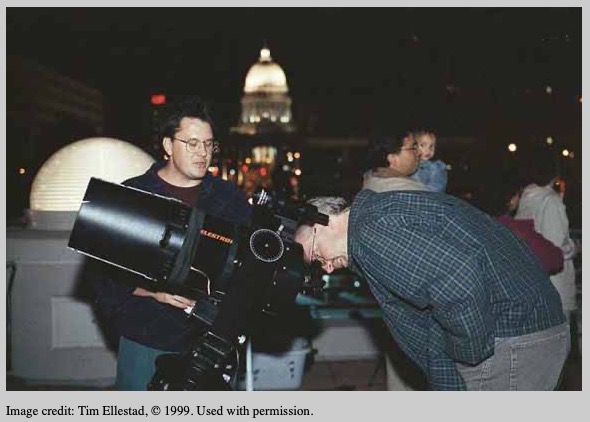
    John Rummel at one of the first Monona Terrace star parties, 1999.
    John Rummel sharing a view of the moon through his telescope, September, 1999. Photo by Tim Ellestad.

    To help make the DPS convention more successful, the UW-based organizers wanted to make sure there would be events open to the public. The scientists would need to present a strong public-facing effort to engage the local populace. One of the ways they did this was to enlist the partnership of the Madison Astronomical Society. SSEC professor Sanjay Limaye and staffer Rosalyn Pertzborn created an array of events that would be open to the public. One of the exhibits prepared by the organizers featured scale models of two cutting-edge spacecraft: Mars Pathfinder and Sojourner, which had become the first celebrity mission of the internet age the year before. Limaye also reached out to MAS for help.

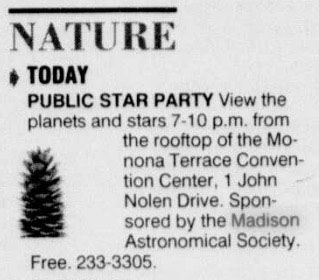
    newspaper clipping about the first Moon Over Monona event

    Member Tim Ellestad was the first to suggest that MAS could host a star party on the roof of the Convention Center. Tim knew that a star party in the heart of downtown was a stretch. Light pollution would make it impossible to view most of the sky, but the planets were bright enough to see through the glare.

    Left: Oct 15, 1998, Wisconsin State Journal

    The dates available to do this event were limited by the DPS calendar, which unfortunately was very close to new moon. So the moon was out as a target, but the event was on! Jupiter was brilliant and Saturn came up just an hour or so later. We could do this! Tim Ellestad worked with Convention Center event staff to make it happen.

    The first Monona Terrace/MAS star party was held on October 15, 1998 and was a huge success. More importantly, the Monona Terrace event staff loved it and recognized that it could potentially be a regular event to engage the public. They asked if we could do it again in 1999 (of course we would). Monona Terrace event coordinator Sharon Neylon came up with the “Moon Over Monona Terrace” moniker, and a yearly tradition and strong partnership was born. MAS has never looked back.

    In the “more than you wanted to know” category, here are the stats:
    Since MAS and Monona Terrace Convention Center initiated this event at the 1998 DPS convention in Madison, October 2025 was the 33rd such event we’ve attempted:

    • The first event, on 10/15/1998, was not called Moon Over Monona Terrace since the event which inspired it (the AAS DPS convention) took place near new moon. Instead, Jupiter and Saturn were the stars of the show. It was just called “Public Star Party” on the rooftop, sponsored by the MAS.
    • Of these 33 events, only 9 have been canceled due to adverse weather and/or the lack of a backup date. 
    • For five years, we experimented with doing MOMT twice annually, once in the fall and again in the spring (2014-2018 inclusive).
    • 3 events were moved to the backup date (and attendance suffered at all three)
    • 3 events were moved to inside spaces in MT and MAS did indoor activities instead of star gazing.
    • 2 events were held virtually due to COVID restrictions (2020 and 2021)
    • Our best attended events were 2011 (over 2000 attendees), April 2016 (1700 attendees), and 2025 (1329 attendees)

    (Posted by John Rummel, September, 2025)

    Back to More MAS History.

  • When Was MAS Founded?

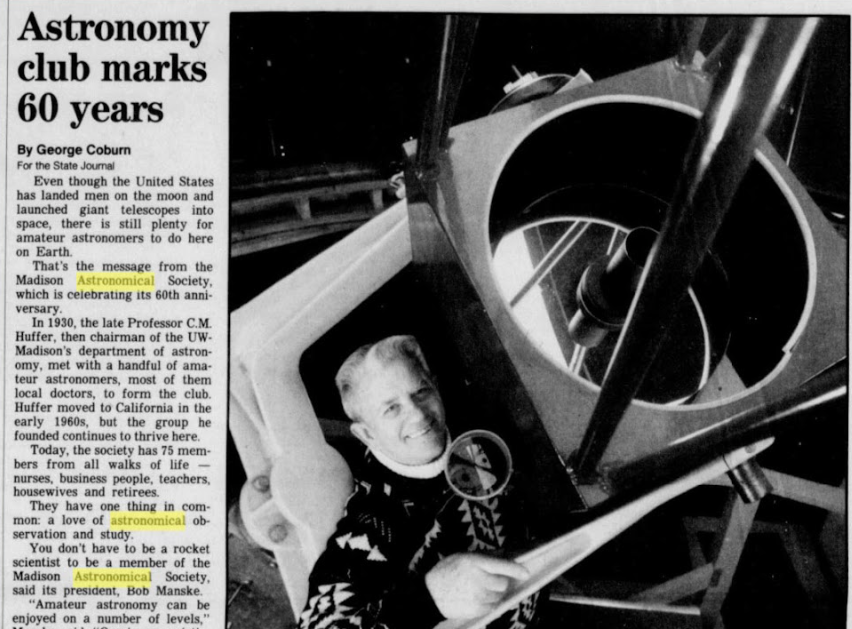
    In 1991, MAS celebrated its 60th birthday as a club. We threw a party, organized various special events, and generally made a big deal of the occasion. And we received some significant coverage in the local newspaper. The club rightly regarded its 60th birthday as an important moment.

    newspaper article detailing club's founding
    April 1, 1991, Wisconsin State Journal. LeRoy Yanna is posing inside the giant fork of the 16-inch Cassegrain in the Art Koster Memorial Observatory (AKO).

    We were mistaken, though. The club was not established in 1930-31. However, we can overlook this error. The club leaders had compelling reasons to choose the 1930 date, and there was little evidence available to them to suggest otherwise.

    By 2020 the club had seriously taken up the task of writing of its own history. The author spent a few hours in some online newspaper databases and found that in the 1930s, the events surrounding the formation of MAS had been extensively covered in the same local papers. By the 2020s, tracking down those documents could be done in minutes without leaving home. Prior to the internet, accessing old newspapers was not easy. Newspaper archives existed only in libraries on microfiche, and indexes—when they existed—were incomplete and difficult to access.

    But in under an hour, I had found documentary evidence of our actual birthday (spoiler alert, it was in early 1935). At the same time, we were collecting many other primary source club documents that further fleshed out MAS’s origin story. We now know the full story.

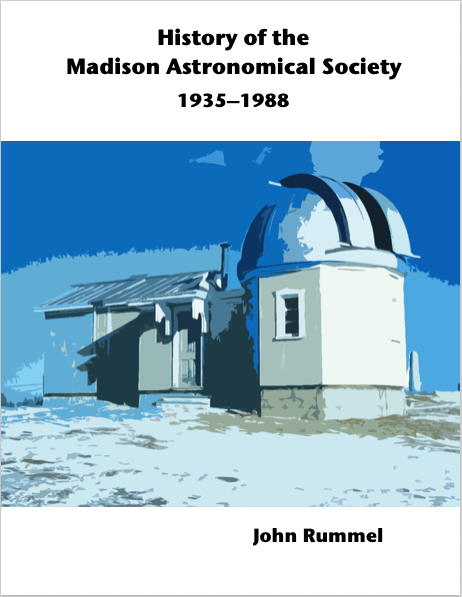
    view of the cover of the History of the MAS booklet

    The History of the Madison Astronomical Society exists in two volumes, available from this website as PDF downloads (find them here).

    The club still has a few print copies floating around but they’re harder to find. If you’re interested, ask us if we can sell you one.

    The story of the club’s history can be found in the volumes linked above. The first chapter of the 1935-1988 volume is all about nailing down the date and circumstances of the club’s founding. It’s all there and it’s a good read, but here’s a quick summary.

    Around 1934, there were several serious telescope makers and amateur astronomers in Madison. Though some of them knew each other casually, there was no attempt to form a a club until UW astronomy professor Dr. C. M. Huffer offered an astronomy class through the UW Extension. The class was quite popular thanks to Huffer’s personable nature and the accessibility of his instruction. As the class was coming to an end, a group of the students approached him and asked if there was a way they could continue to meet. Huffer told them that they were describing an astronomy club, and he encouraged them to form one. Huffer knew of a few of the telescope makers and put them all in touch with one another. By the end of February, 1935, they had organized a first meeting, drafted a constitution, and elected officers.

    A few months later one of them, Dr. Jack Supernaw (elected president of the new group), would write in its first newsletter:

    It is significant, when the Extension Department of our State University announces a twelve-week course in popular astronomy, to have forty-seven in attendance for the first lecture. It is significant that among these forty-seven were housewives, grade and vocational teachers, nurses, oil station attendants, doctors, store-keepers, lawyers, and ministers—a cross section of diverse interests and tastes but a lay group with the common desire to know more about the mystery of the universe . . . The common need for discussion and “mutual benefits that evolve from congenial associations” gave rise to the organization of our present group.

    There’s more to it than this, of course, and the story is a good one. The club they formed in early 1935 still exists today. Reading about their activities, interests, and dreams will sound familiar to today’s members. There are differences, of course. Technology has put a much different twist on the hobby, but it still comes down to the people you’ll get to know when you visit a meeting. We’re still a group of housewives, teachers, nurses, storekeepers, lawyers, and ministers—and much more.

    By the way, in 2025, we celebrated the club’s 90th anniversary!

    (Posted by John Rummel, September, 2025).

    Back to More MAS History.

  • Jack English’s Telescope

    1940 photo of MAS founder John English

    John M. “Jack” English, (1901-1958)

    English was part of the small group of MAS founders. He was an avid telescope maker and served as the club’s first secretary/treasurer in 1935-36. And his grandkids vividly remembered the telescope that stood in his yard.

    1940 photo from his grandchildren

    Jack English was born in Platteville and earned his teaching degree from the Platteville Normal School (now UW Platteville) in 1923. He taught in several school districts around southern Wisconsin before taking a position at the Madison Vocational School teaching chemistry. He would stay at the vocational school for 29 years.

    In the early 1930s, English was actively sharing his hobby of telescope making with the public and mentoring others in the craft. His friendship with Bill Binney (another founder) led him to be part of the core group that formed MAS. Because of his position at the vocational school (later, MATC), many early MAS meetings took place in classrooms or meeting rooms at their building on S. Carroll St. in downtown Madison.

    In 2021, as the MAS history project was in full swing, I got in touch with a couple of Jack’s grandchildren, who live in Michigan and Ohio. They provided many memories and details of their grandfather’s life and love of astronomy, and shared with me the historical photos that appear in this post.

    As we were talking about English’s love of astronomy, they said, “Have you been to his house? His telescope is still in the yard.” I gently explained to them that telescopes that were set up in the out-of-doors 70 years ago were surely long gone. But they stood firm, telling me that they had all visited Madison the previous year and drove by Grandpa’s old house. “The telescope is still there!” they insisted.

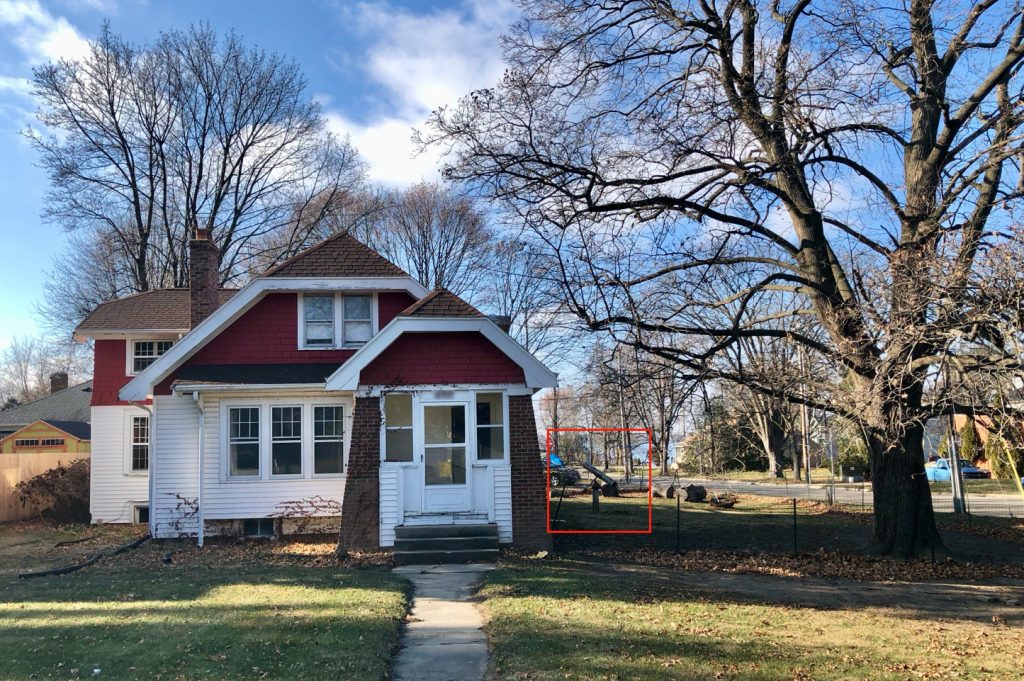
    So they gave me the address and I made the pilgrimage to Monona Drive on Madison’s east side.

    John English's house on Monona Drive in Madison.
    Jack English’s former house in Madison, WI. Photo by the author in 2021.

    Jack and Gladys English raised their son in this house.

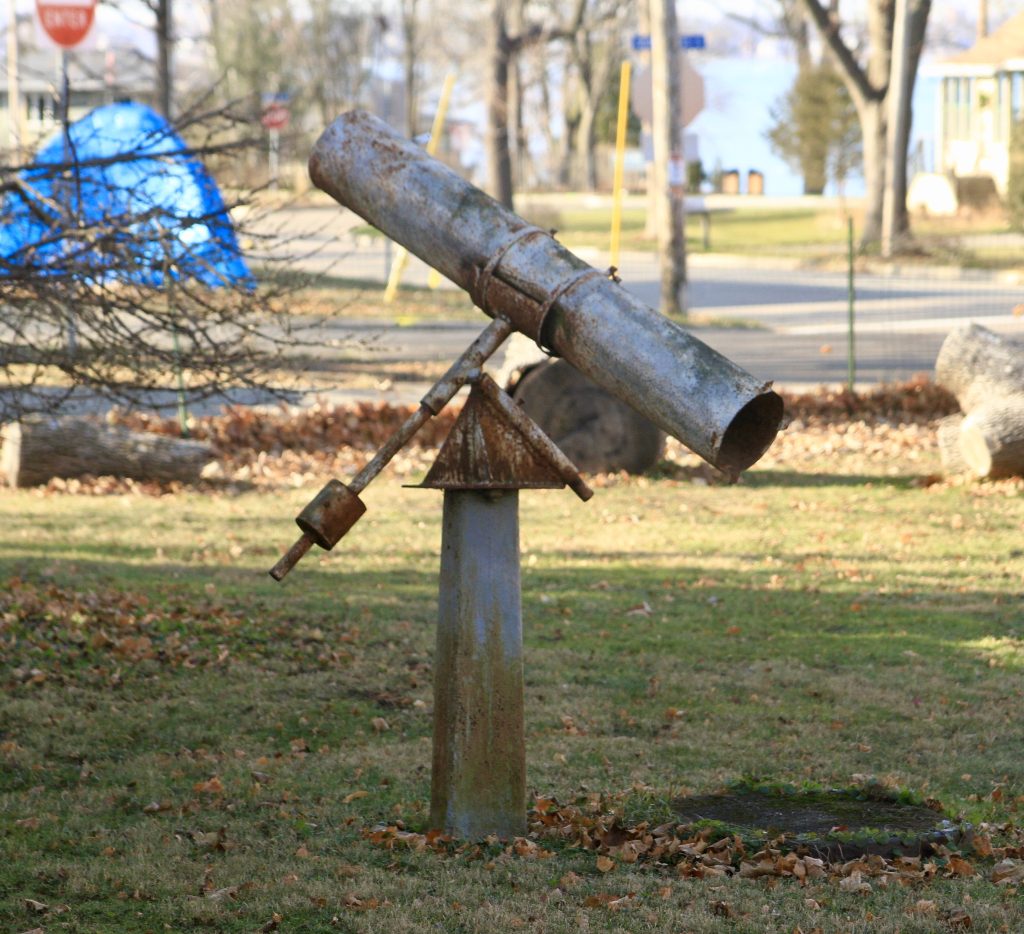
    And Jack’s telescope is still there.

    Note the highlighted region in the side yard. English’s telescope is not in great shape, and obviously hasn’t been functional in many years, but it’s still standing. (These pictures were taken in the fall of 2021 but I’ve been back as recently as the summer of 2025. I’m happy to report that it’s still there.)

    John English's telescope, detail.
    Jack English’s telescope, still standing after over 70 years.

    Based on the condition of the tube, mount and pier, it’s been exposed to the elements since it was built in 1930s (see photo below). The tube is empty, there’s no mirror cell, secondary assembly, or focuser. And the equatorial mount is not aligned to north.

    The house on Monona Drive is not the English’s—or the telescope’s—first home.

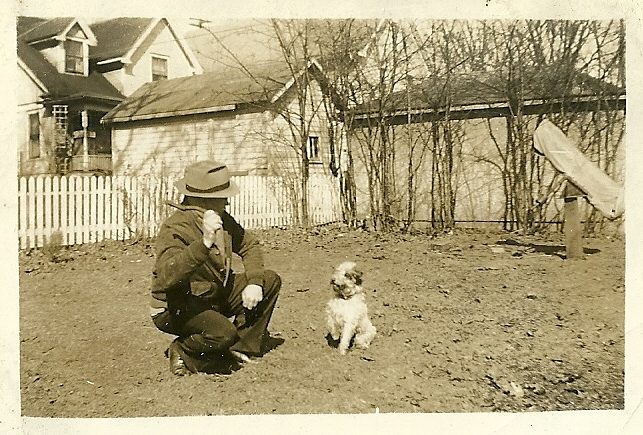
    John English and his dog Sally in the backyard of a previous Madison home.
    Jack English and dog Sally in the backyard of his first Madison home at 2317 Oakridge Ave, 1939 photo.

    A close examination of this photo reveals that the same telescope, pier, and mount are present, but the location is not the Monona Drive house. From this, we can infer that English constructed the telescope and pier sometime in the 1930s, most likely at his previous home on Oakridge Ave. He subsequently relocated it with him to Monona Drive. Although only the optical tube, elements of the equatorial mount, and pier remain today, it’s evident that this device was meticulously crafted.

    Jack English’s telescope is roughly the same age as the MAS, and bears a metaphorical resemblance to it. Their shared origin story lies in English’s co-founding of the Society and his passion for telescope making. Both survived the years (and Madison’s harsh climate) because they were well-designed and carefully made.

    I managed to track down the current owner of the Monona Drive property. The people who own the house now are the children and grandchildren of a Mr. Goff, who purchased the property from the English family upon Jack’s death in 1958. The story that came down through the Goff family during their long tenure there is that the original owner of the house was a professor of astronomy at the UW-Madison. I was able to offer a correction to the legend of the telescope and let them know that the real story is even better – that of a humble teacher, amateur astronomer, and telescope maker – and co-founder of the Madison Astronomical Society.

    (Posted by John Rummel, September, 2025. Parts of this post are recycled from the biographical sketch written for the MAS History.)

    Back to More MAS History.

  • Paula Birner Carey – S&T Article

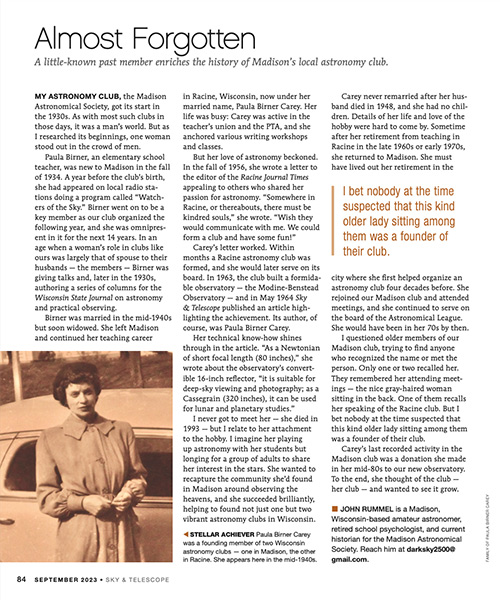
    Small version of Sky & Telescope Focal Point article on Paula Birner Carey

    In the September, 2023 issue of Sky & Telescope magazine, I was lucky enough to have my article about the history of MAS published. It was my biographical profile of the extraordinary Paula Birner Carey, a co-founder of MAS. The full text of the article is reproduced below.

    Almost Forgotten

    A little-known past member enriches the history of Madison’s local astronomy club.

    by John Rummel

    MY ASTRONOMY CLUB, the Madison Astronomical Society, got its start in the 1930s. As with most such clubs in those days, it was a man’s world. But as I researched its beginnings, one woman stood out in the crowd of men.

    Paula Birner, an elementary school teacher, was new to Madison in the fall of 1934. A year before the club’s birth, she had appeared on local radio stations doing a program called “Watchers of the Sky.” Birner went on to be a key member as our club organized the following year, and she was omnipresent in it for the next 14 years. In an age when a woman’s role in clubs like ours was largely that of spouse to their husbands — the members — Birner was giving talks and, later in the 1930s, authoring a series of columns for the Wisconsin State Journal on astronomy and practical observing.

    Birner was married in the mid-1940s but soon widowed. She left Madison and continued her teaching career in Racine, Wisconsin, now under her married name, Paula Birner Carey. Her life was busy: Carey was active in the teacher’s union and the PTA, and she anchored various writing workshops and classes.

    But her love of astronomy beckoned. In the fall of 1956, she wrote a letter to the editor of the Racine Journal Times appealing to others who shared her passion for astronomy. “Somewhere in Racine, or thereabouts, there must be kindred souls,” she wrote. “Wish they would communicate with me. We could form a club and have some fun!”

    paula birner carey headshot

    STELLAR ACHIEVER Paula Birner Carey was a founding member of two Wisconsin astronomy clubs — one in Madison, the other in Racine. She appears here in the mid-1940s.

    Carey’s letter worked. Within months a Racine astronomy club was formed, and she would later serve on its board. In 1963, the club built a formidable observatory — the Modine-Benstead Observatory — and in May 1964 Sky & Telescope published an article highlighting the achievement. Its author, of course, was Paula Birner Carey.

    Her technical know-how shines through in the article. “As a Newtonian of short focal length (80 inches),” she wrote about the observatory’s convertible 16-inch reflector, “it is suitable for deep-sky viewing and photography; as a Cassegrain (320 inches), it can be used for lunar and planetary studies.”

    I never got to meet her — she died in 1993 — but I relate to her attachment to the hobby. I imagine her playing up astronomy with her students but longing for a group of adults to share her interest in the stars. She wanted to recapture the community she’d found in Madison around observing the heavens, and she succeeded brilliantly, helping to found not just one but two vibrant astronomy clubs in Wisconsin.

    Carey never remarried after her husband died in 1948, and she had no children. Details of her life and love of the hobby were hard to come by. Sometime after her retirement from teaching in Racine in the late 1960s or early 1970s, she returned to Madison. She must have lived out her retirement in the city where she first helped organize an astronomy club four decades before. She rejoined our Madison club and attended meetings, and she continued to serve on the board of the Astronomical League. She would have been in her 70s by then.

    I questioned older members of our Madison club, trying to find anyone who recognized the name or met the person. Only one or two recalled her. They remembered her attending meetings — the nice gray-haired woman sitting in the back. One of them recalls her speaking of the Racine club. But I bet nobody at the time suspected that this kind older lady sitting among them was a founder of their club.

    Carey’s last recorded activity in the Madison club was a donation she made in her mid-80s to our new observatory. To the end, she thought of the club — her club — and wanted to see it grow.

    JOHN RUMMEL is a Madison, Wisconsin-based amateur astronomer, retired school psychologist, and current historian for the Madison Astronomical Society.

    Published in the September, 2023 issue of Sky & Telescope magazine, page 84 (Focal Point column).

    Back to More MAS History.