
At this year’s “Moon Over Monona Terrace Convention Center” event, John Rummel teamed up with Bob Hamers, who brought his 9.25-inch Celestron EdgeHD telescope. A low-pressure system cleared out just in time, leaving us with pristine skies and excellent atmospheric conditions. We were able to treat attendees to highly magnified views of the Moon, Saturn, and Neptune. The seeing was so steady that we were able to push the magnification even higher than usual, giving us some truly breathtaking views of Saturn.
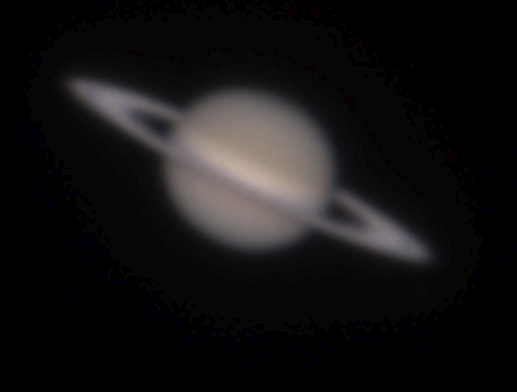
While we were sharing the sights with the crowd, Bob decided to capture some video. When someone asked, “Why video instead of a regular photos?” John explained the process: by taking thousands of quick frames, we can discard the blurry ones affected by Earth’s turbulent atmosphere and combine—or “stack”—the sharpest ones. They asked if the final pictures would be available publicly, so here they are.
Technical Details
These images were captured using a Celestron EdgeHD 9.25” Schmidt-Cassegrain telescope (SCT) on an iOptron CEM70 mount, paired with an ASI224MC camera and a ZWO atmospheric dispersion compensator (which helps correct for the color fringing caused by Earth’s atmosphere).
Bob used a technique called “lucky imaging,” which involves recording video to freeze the motion of the atmosphere, then selecting only the clearest frames.
Saturn: The sharpest 3% of 831 video frames (each a 62-millisecond exposure) were stacked using Autostakkert. The resulting image was sharpened in Registax using wavelet sharpening and cropped in Photoshop. No contrast adjustments, stretching, or color modifications were made.
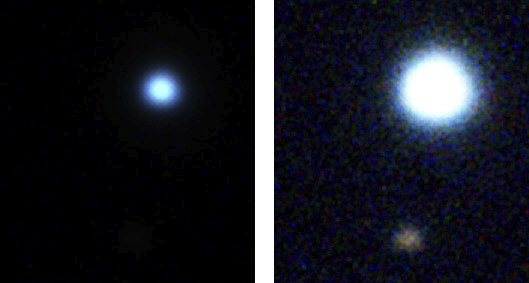
Neptune: Because Neptune is much dimmer, it required longer exposures (550 milliseconds). Bob stacked the top 20% of 157 frames in Autostakkert and cropped the image in Photoshop. To make Neptune’s moon, Triton, visible in the same frame, the brightness was “stretched” using the Curves tool in Photoshop. No sharpening or other modifications were applied.
(Posted by Bob Hamers and John Rummel, October 18, 2026)