Friday, Jan 9, 2026, 7:00 PM, UW Space Place
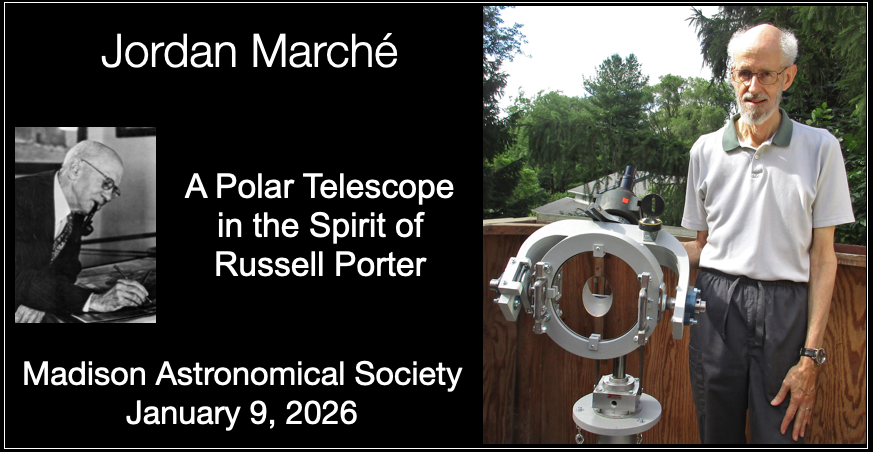
The design for this unusual telescope, which features a polar-aligned, fixed eyepiece, takes me back several decades. At the time, I was investigating warmed-room observatories, many of which had been featured in the well-known Amateur Telescope Making book series (three volumes). One of the simplest of these had been constructed by Russell W. Porter (1871–1949), principal founder of the amateur telescope making movement, which (in the U.S.) began in the early twentieth century.
Porter’s small sketch and brief account of his device, which appeared in the series’ first volume, were intriguing. But after using this configuration for several years, Porter abandoned the design, because of the awkwardness of looking up its fixed polar axis. This, in turn, caused me to wonder if the entire design could not simply be turned 90° onto its side which would then allow an observer to look comfortably down the polar axis. As the talk will explain, this meant that viewing would be restricted to the southern skies. But for lunar and planetary viewing, that was no hindrance at all.
Jordan Marché is a retired astronomy educator whose most recent post was that of senior lecturer in the Department of Astronomy at the University of Wisconsin–Madison. Yet, he has been an amateur telescope maker from the time that he was fourteen years old (1969). Over his lifetime, Jordan has ground, polished, and figured a dozen optical surfaces, all by hand, by the method of ‘walking around the barrel’. These include several spheres, both long and short-focus, up to 10 inches in diameter; paraboloids as large as 12.5 inches in diameter, including a 6-inch off-axis mirror; the convex hyperboloid for a 6-inch Cassegrain telescope (whose primary mirror was the first that he learned to perforate so as to avoid using a star diagonal); and two optical flats, including the one described here. He builds telescopes in order to see if he can build them. He has performed optical ray tracings on different computers to investigate the aberrations of star images found in a variety of reflecting telescopes (including one that will probably never be built!). He has also built, or helped to build, four amateur observatories (the first when only 14 years old), three of which featured revolving domes that were up to 12 feet in diameter. A few of these other accomplishments will be touched upon in his presentation.
This meeting will take place in-person at our usual Space Place classroom location. It will also be streamed live to our Youtube channel at https://www.youtube.com/@madisonastronomicalsociety. Space Place is located at 2300 S. Park St., Madison, WI.